Showing posts with label Annapolis. Show all posts

Monday, December 14, 2015

The Place We Keep Coming Back To (Annapolis, MD, -- again!)

As we wound down from our incredible, spectacular summer on El Galeon, it was time to get back to everyday life. Being grownups, we knew that we would now have to get after the chores and errands we had postponed in order to go exploring.  One of those chores was the dreaded "medical monitoring marathon" with our specialists in Annapolis.  The second chore, long delayed, was the sorting and emptying of our storage unit in the same city. And while we were in town, not a chore but a treat, was the chance to check in with several of our area friends.

Annapolis! (Photo by Rdsmith4 under creative commons license, image from here)

We spent 6 years living aboard and working in Annapolis, then after retirement and becoming snowbirds, we came back most summers after wintering in warmer climes.  I love the amazing sailing and gunkholing available in the Chesapeake, one of my favorite places for spending summer and early autumn afloat.  I think of misty sunrises and miles of shoreline with intricate sheltered coves for anchoring, no tides or currents to worry about, pretty towns and old brick streets and colonial architecture. But those are summer memories.  The medical marathon as well, is usually a summer project, while we are in the area; but this year we were going to make the trip in (gulp) dark, chilly November. This trip was going to be by car, not boat, and we'd be staying in a motel, not at anchor. On the other hand, a trip that generally takes us 6-8 weeks of ICW and offshore sailing, would take only about 13 hours by car.

All my Chesapeake Bay icons in one photo: misty dawn; heron on a daymark fishing with the Bay Bridge in the background

Of course, not even delicious ease of cruising or pretty scenery is sufficient to make a place "home," though Annapolis has as solid a claim to the title as anyplace we've ever set the hook.  Add in our many wonderful friends there, and an environment more congenial to our left-of-center political leanings, (let's face it, north Florida, while interesting, and warm, isn't exactly a hothouse of liberal intellectualism), and Annapolis wins front-runner status. Then, add the just flat-out convenience and freedom of having a car again for a while, and the chance for some silly stuff, like stocking up on some of our favorite specialty food items (Trader Joes and Whole Foods and Fresh Market, all within a few blocks of each other!) to the feeling of going "home" and suddenly instead of being overwhelmed with errands, we're looking forward to a road trip.

One warm Saturday we were busy playing pirate in St Augustine, next morning we got in our rented mini-van and drove 13 hours, with stops for indulgent waffles for lunch and broiled fish for dinner, (at the last minute gotta eat healthy before our blood tests) before checking into a comfortable motel just outside of town for the night. Early Monday morning began what was destined to be our pattern for the incredibly tightly-scheduled week: every day had one (or more) doctor's appointments; numerous afternoons included shopping for things that we just haven't been able to find in Florida or that were simply easier to get while we had a car; every evening -- and a few lunches -- our reward for our work was meeting one or more local friends for a meal at a different restaurant, mostly our old favorites but also some new to us.  Also on that crammed and confining schedule were several blocks of time dedicated to the dreary task of cleaning out our storage unit.

Originally the storage unit held a sparse collection of cruising gear like jerry jugs and spare dock lines; and off-season stuff like our winter enclosure and space heaters during the summer, the sails and inflatable kayak and snorkel gear during the winter; and some practical stuff like tax records that we have to keep for 3 years. But over time it also accumulated souvenir t-shirts, books we had read and wanted to keep (but not necessarily keep on board), leftover materials from boat projects, and other randomness. We planned to sort through it all, bring the good stuff back to St Aug with us, and jettison the rest.  

Boxes of books and papers and tools and clothing came to the motel room to be tried on, sorted, repackaged as compactly as possible.  We had a large stack of cardboard boxes at one end of the room "to be sorted," and another stack of (mostly) plastic boxes at the other side "finished."  Slowly the "to be sorted" stack decreased and the "finished" stack grew. Some of the stuff we revisited was greeted with incredulous looks, "Why did we save this?"; some clothing to my delighted surprise fit me well and looked good again after the weight I lost over the summer. We had a competition to see who could find the silliest, most useless thing we had wasted storage space on.

Pizza with a subset of our Annapolis boating friends ... and "adult beverages"
Then we'd go out to lunch or dinner to meet with our sailing friends, or or meet someone's new baby, or shop for favorite foodie items.  For all that it seemed we hadn't been away that long, there were lots of minor changes in town -- a new restaurant here, a road there -- and more changes in our friends' circumstances -- Juan and Maria were selling their boat; Bryan and Sharon had a new baby for us to meet; Jen had a new business; John and Penny were going on a ski vacation while John and Diane were going on a tropical vacation; Keith and Kim were talking retirement; "S". was getting divorced; "J.'s" cancer was in remission; Eric and Carleen were all about their grandchildren; it was like we'd never left and simultaneously hard to believe that all these changes had come about in just a little over a year since the last time we'd been in town. It occurred to me that the cliche "ebb and flow of life"  was a cliche for a reason. The phrase was used a lot, because it was, well, true.  The results of our own medical monitoring marathon were coming back excellent, but it was good that we had done the blood tests on the first morning of the first day -- over the course of the rest of the week, all that catching up over meals, eating out and drinking was putting on weight.

The week was winding down but what wasn't decreasing at a parallel rate was the volume of stuff we were planning to move to our newly-rented storage unit in St Aug. We were sorting, packing, repacking every day.  We made multiple trips with boxes of donations to The Clothes Box, laughing with the volunteers there that we could donate winter coats and boots and heaters because we were snowbirds now and headed to Florida.  We also made multiple trips to Office Depot to buy more plastic storage boxes for things we were keeping, and multiple trips to the dumpster to throw away things that we could neither keep nor donate.  We were feeling the pressure and the space constraints. In the chilly dark on the last evening we started making bad decisions: at one point Dan declared a carton of odds and ends "trash" but fortunately before we pitched it I noticed that it was strangely heavy. In the dark neither of us had noticed that our router (power tool, not the tech item) was in there -- saved just in time! But speaking of tech, he also handed me a rectangular item just after we'd been talking about the dead old netbook computer that we had kept, and I hurled it into the dumpster. 1,000 miles later when we were unpacking in St Augustine I found the netbook ... so what did I throw away there in the chilly dark in Annapolis? A month later and I still can't identify anything missing; what does that say about the nature of our storage?

Van interior on arrival in St Aug. Stuffed!

The van was so packed (thank you Chrysler "Stow and Go" folding seats) that I'm almost afraid to post a picture of it lest Enterprise revoke our rental privileges for misuse -- but here's a picture anyway. Still it was seriously the most comfortable vehicle we've ever rented. The van was so full that the passenger had a backpack in their lap (no other space for it) and our box of marine stainless steel fasteners between their feet. And Jaye drove the entire way because we couldn't push the driver's seat back far enough for Dan's long legs. But we made the trip without incident and within a couple of hours had everything offloaded into the storage unit. We used the now-empty van for a trip to get groceries and to just gaze at the ocean for a while, and then settled into the feeling of being "home" with our stuff, missions accomplished.

=======
So why are we moving our stuff to St Aug, changing our drivers' licenses, and giving every indication of settling here if we think of Annapolis as home? All other things being equal, there are tax advantages to declaring ourselves Floridians instead of Marylanders, and we legitimately have equal claim to both states. In our minds, Annapolis is our long-term home, St Aug is home-for-now. In past years, we spent 4 months of winter in St Aug, 2 months traveling north, 4 months of summer in Annapolis, and 2 months sailing south, so we have equal claim to both cities, some summers we didn't make it to the Chesapeake, and some winters we went further south than north Florida.  Both cities have a good access to water and a supportive boating community, a nice mix of educational and entertainment options -- what we consider and at the least the right ratio of bars to bookstores -- the ambiance of being a university town. Both have all the characteristics of a place with a high comfort level that we will keep coming back to.

Friday, August 1, 2014

Back to Annapolis, Just for a Visit


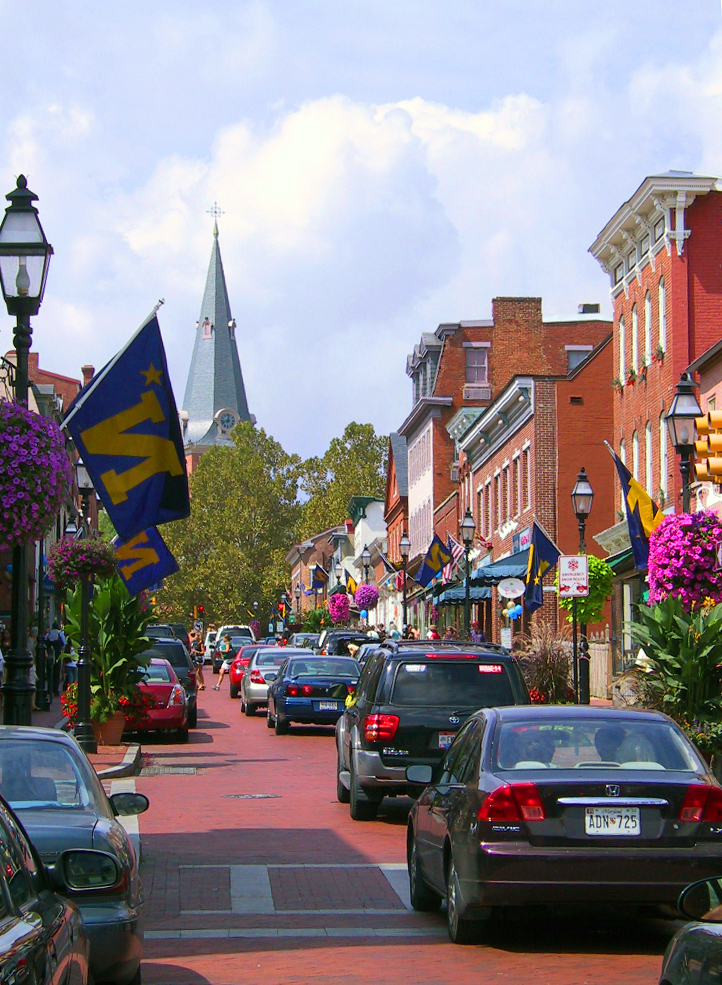
 Car-centric.  What's wrong with this lovely sunshiny photo of downtown?
Kinda hard to see the buildings for the cars, isn't it?
(Photo "Annapolis street" by Rdsmith4 - Own work.
Licensed under Creative Commons Attribution-Share Alike 2.5 via Wikimedia Commons - link here)

While our boat was at the boatyard awaiting major work, we took advantage of our borrowed car to return to Annapolis for two weeks.  I have to admit that I faced the trip with a mixture of excitement and trepidation.  I had always claimed that Annapolis was "home," the place I want to come back to when our traveling days are done.  But what makes a place, this place, feel like home?   After a year away, would I come back to Annapolis, fit right in where I left off, and heave a giant sigh of relief, “ahhh, I’m back!” Or, after traveling and comparing it to other places I’d been, would I see the flaws and make a sound more like “eeeuw, I’m ba-ack!”

The official reason for the trip was practical. We call it our "medical monitoring marathon" -- the annual check-in with the doctor, the dermatologist, neurologist, eye doctor, etc.  (Cause for celebration, BTW, there is no longer an annual check-in required with Dan's oncologist, because Dan is medically boring.  After eight years with no sign of cancer recurrence, Dan now gets an MRI every year but the doctor said he has no need to spend an office visit on a perfectly healthy man like Dan, and wants instead to spend his time "on folks who actually need me.")

In between appointments, there was plenty of time for other things.  We spent a fair amount of time and reflection just revisiting our remembered favorite spots in town.   We had spent most of the last year carless, and now, having a car again, I was aware of the way the pedestrians and the vehicles coexisted.  Our first drive through downtown was troubling. Had the city always catered more to cars than people, or was I hypersensitized?  Streets, widened from their colonial proportions to accommodate more cars and parking, extended until they butted up abruptly within inches of the doors of historic buildings and homes.  In other cities we’d seen in our travels, the downtown waterfronts were grassy parks and boardwalks and park benches, a few shops and restaurants, historic structures and educational plaques.   There was no comparable grassy area at City Dock, though; boasting an excellent view of the beautiful Chesapeake was … a parking lot.  Really?

The things I found comfortable about living in Annapolis were still there, though.  It was handy knowing where things were without the need for a map.  It was easy to pick up boat parts and services -- Dan scored a great half-price sale on a good quality foul weather jacket at Fawcetts, and the replacement canisters for our water filter were an off-the-shelf item instead of special order.  Our favorite food items, both ordinary and quirky, were available at Trader Joes or Whole Foods or Giant or Fresh Market.  Politically, we stand rather to the left of the current U.S. average; we fit in well here.  I love the wonderful sailing and gunkholing possibilities.  I love the museums and the cultural opportunities and the college influence. I liked our doctors and my awesome physical therapist.  But. Boat parts and grocery stores and doctors do not alone make a place “home.”  Comfort alone certainly does not make a place home.   If you're flexible, you can find (or create) comfort anywhere.  And doctors retire and boat parts are available by internet.

Even friends aren’t enough to make it home.  Visiting friends was equally important, in our minds, as checking in with doctors. But we knew that the loose but large gang that we hung with at the marina had shifted and scattered in the time we'd been gone.  A few friends moved to other cities for their jobs, three sold their boats and moved ashore, two others retired and sailed away. That’s the way it is with boat people, we’re inherently mobile. We could make new friends, of course.  But, as Dan pointed out, the community of boating friends I remembered as such an integral part of my mental picture of what I loved and missed about Annapolis no longer existed. We couldn’t have had that any more, whether we had stayed or gone.  So, with so many of our friends gone, would it still feel like home?

Several good friends remained in town though, and we were lucky enough to spend some time with each of them.  I met my BFF Karen and her husband in college.  Forty years ago, we speculated on our future careers in late-night dorm sessions; last weekend, we strolled through a great sculpture garden and speculated on retirement.  It amused me to realize how much of our life cycle we've shared!  We also spent a few days visiting fellow blogger s/v Octopussy.  They live in one of the historic homes on the Naval Academy, so in between appointments we had a great opportunity to catch up on life news and swap stories over (several) glasses of wine, enjoy some military parades, and revisit the wonderful U.S. Naval Academy museum at Preble Hall. The few days we spent with them exposed me again to the very best of Annapolis, and restored my faith.

So, is Annapolis “the one?”  My personal “best place?” I didn’t come to any answer, nor do I need to yet.  We have many years of travel on the boat ahead of us.  For now, our best life involves migrating north and south with the seasons, enjoying many cities, rather than settling down in just one.


Thursday, May 16, 2013

What Kind of Error Would You Rather Make?

Yep.  It's another anchoring post.  My last one is here.

The plan was to get a few boat friends together, pick up a Navy mooring in Weems Creek, raft together, then go out to Mexican CafĂ© on Saturday night to celebrate an early Cinco de Mayo.  If we had one too many margaritas, we only needed to walk/row back to the boats to sleep instead of driving home.  The weather report was encouraging, for warmth and some sunshine after a chilly spring that has seemed to go on forever.  We arrived at the planned meeting point at Weems Creek after a brief pleasant Friday afternoon sail to find … disappointment.  No moorings were available; they were occupied by a number of dilapidated, neglected or abandoned boats – one covered with a threadbare tarp, one without a mast, one trailing a deflated waterlogged dinghy. There was still some prime anchoring real estate available, so we set the hook and let out plenty of chain, and got our heads into weekend mode.

We spent a pleasant day chatting with other boats in the anchorage, old acquaintances who had returned to the Chesapeake for the summer.  We met some new folks who, drawn by our hailing port of Northport, Michigan, came over and introduced themselves as fellow Michiganders new to the Chesapeake.  And then our gang showed up, some by boat, and others came to the restaurant by land.  Much laughter ensued; later there were even fireworks we could watch from the cockpit.  The derelict boats spoiling the mood were reduced to a minor annoyance, grit under my fingernails or pebble in my shoe, but the irritation never completely went away.  As the boats themselves will never go away, which is of course the issue with abandoned boats – they cost tax dollars to remove.

There was a recent situation elsewhere in A.A. County that was diametrically opposite: a police launch came along side an anchored boat and very politely said that one of the shore residents had suggested perhaps that boat had stayed long enough and should be moving on.  The heavy irony here is that the boat in question was an extremely beautiful and well-maintained one; the owners, Evans Starzinger and Beth Leonard, long-distance sailors well-known in the cruising community, were aboard; and there was no chance of mistaking this for a dilapidated boat about to be abandoned.   (For Evans’ take on the incident, go to their blog  and scroll back to the post from 4/16/2013; another blogger's reaction to his post is here) In addition, there are no regulations prohibiting anchoring in the Chesapeake as long as the boat is properly lit and not blocking a channel or access, so I'm not sure which I find more disturbing, that a shore resident thought he/she had a right to control who anchored nearby, or that the local law enforcement did nothing to disabuse him/her of that notion.

The inconsistent, in fact contradictory way local authorities react to anchored boats in the county is confusing, or worse.   In one case, boats are allowed to sit unattended for long periods; in the other, a properly-anchored and attended boat was asked to move.

In statistics they call them Type 1 and Type 2 errors.  The technical definitions include lots of confusing phrases like “failing to reject the null hypothesis,” but it’s simpler to think of them as “false positives” or over-reacting, and “false negatives” or under-reacting.  See, in the real world, no matter how you make the decision rules, it is likely that there will be a few extremes or special cases that aren’t properly covered.  The trick is to define the rules in a way that minimizes harm from these errors.  In some cases it is very clear to see which type of error is the more dangerous.  If the rule, for example, is about a new cancer screening, then a false positive means some people will get unnecessary followup tests even though they don’t have cancer.  But a false negative means some early cancers will be missed until it is too late, and people could die.  So you skew your test to have very few false negatives, even if that means you might have more false positives – you over-react.  The Coast Guard does the same thing with “mayday” calls – they’d rather go out on a false alarm or multiple false alarms, than miss someone in danger that they could have helped.  In other cases, false positives are clearly the more dangerous error: for all its faults, our judicial system is skewed to minimize the chances of an innocent person being found guilty, even if that means that some guilty may go free.

There are other cases when it is not clear whether type 1 or type 2 errors are worse.  My favorite example of this is the rules for eligibility for public assistance.  No matter how we write the rules, some people just won’t fit in those boxes and their circumstances won’t be covered properly.  If we write the rules too broadly, there is a chance that some freeloaders will game the system.  But if we write the rules too strictly, there is a chance that some folks who really deserve help will fall through the cracks.  There’s no obvious right or wrong answer, but which type of error we are more tolerant of says a great deal about our values as a society.

Perhaps the case of abandoned boats in Weems Creek is a “Type 2” error, and the seaworthy boat asked to move along is “Type 1” error?  In writing public policy, it is hard to find a perfect balance.   Write the anchoring rules too lax, and you get derelict boats that we all (somehow) have to deal with.  Write the rules too stringently, and no one ever anchors out and learns to appreciate the natural beauty of the Chesapeake.  Right now, we’re making both types of errors; do we have the worst of both? Which error are we more concerned about? What do we value?
= = = =
Life Afloat on Facebook: https://www.facebook.com/pages/Life-Afloat/211190278933810
A slightly different version of this post was first published in the Annapolis Capital-Gazette on May 11, 2013:

Saturday, February 2, 2013

An Image of Winter

Obviously, no photos of my own for this post.  So instead, I offer this; snowflake science image from  here.
I am just loving this winter stuff!  (Okay, the novelty hasn't worn off yet - the last time we saw snow was 2008.  And - big plus - we don't have to drive to work in it!)  But Thursday night they were calling for snow.  I needed a photo for something I'm writing about "Living Aboard in Winter" (more on that project later), so I decided this would be a perfect time.  I visualized the photo in my mind's eye: a thin dusting of snow on a dock cleat.  And I knew exactly where - a few slips down from us is a boat cleated off with bright blue line that would make a perfect image.  So I charged the camera batteries and laid out my warm jacket, and went to sleep.

In the morning, after a first cup of coffee but before anyone was out to disturb the fresh powder, I bundled up and went ashore ... only to discover that too much snow had fallen!  My dock cleat was just an indistinguishable mound of white.  Not that I would have believed there was such a thing as too much snow in any other context. I love the way the white blanket transforms the world, but today, I was on a mission.  I also knew that I could stage the photo using a box of kosher salt as "snow" although I hadn't expected to need to do that yet.  I wandered around the marina looking for likely dock cleats, to no avail.  Cold and hungry, I came back aboard empty handed, or rather, empty memory-carded.  

...Only to find a facebook page filled with snow photos from other boating friends.  Helen posted icicles on her dock railing; Cathy posted a snowbound lighthouse; Jody posted snowflakes and ice crystals on her isinglass.  And I had, well, nothing.  I had been so intent on looking for the exact image I wanted, that I failed to see all the other possibilities around me.

But no fear, it's supposed to snow again tonight.  This time, I'll be ready.

Friday, September 16, 2011

Clarification: I’m “Houseless,” not Homeless


Posted: June 16, 10:48 am | (permalink) | (2 comments)
I believe one of our jobs as members of the human race is to help build the world we want to live in. Part of the world I want to live in is one that is welcoming and understanding of why I choose to live not in a suburban house or city apartment, but full time aboard a sailboat. That was why we picked Annapolis, advertised as the Sailing Capital, for our home, and why I started this blog – to help increase the community’s knowledge of what living aboard is all about.

So I think I have some work to do! I really feel a need to respond to two views quoted in Elisha Sauers’ recent article “Back Creek Could Get Anchoring Restriction.” Her article nicely presented views on both sides of the issue of transient –and in some cases long-term – boats anchoring in a cove near the dinghy landing at the end of Sixth Street. It is a convenient location for many, but at the same time, boats anchored there improperly can complicate access for other boats in nearby marina slips, or drag and cause damage.

The first quote I’d like to respond to comes from the manager of Mears Marina, proposing the anchoring ban. She says, "Really, these people [her slipholders] are paying to be here, they're paying into the establishments here, they're paying taxes here, they're contributing to this economy. The others [anchored boats] aren't contributing anything to us." I disagree – I think that anchored boats contribute to the local economy, just not to the marina segment. Many of the anchorers are visitors passing through Annapolis on their way north for the summer or south for the winter. If it were me, I’d pick someplace more tranquil if I was just going to stay aboard my boat for the night. Otherwise, why anchor in a city, near a convenient dinghy landing, if you don’t intend to go ashore? And do what, ashore? Tour the historic district or the Naval Academy or other tourist attractions, go out to dinner, contract for boat repair work. In other words, spend money in our town. Tell friends about your experiences, move on, return, repeat.

The second quote I’d like to respond to is one that compares anchored boats to a “homeless person living in a box in [your] apartment complex." I think this is a bad analogy for two reasons. The first is that an apartment complex is private property that someone living in a box is illegally encroaching on, while the cove on Back Creek is public property and, at present, anchoring there is legal.

The second reason I think this is a bad analogy gets to exactly why I started this blog: liveaboards are not homeless. We have homes, just, floating ones. When I first moved aboard I was pretty quiet about where and how I lived, especially with my new boss, wary that he also might have fallen prey to the image that liveaboards were a bunch of rebels and dropouts and losers. (I blogged about it back in my very first post.) Indeed, there are a few liveaboards that fit that image. But the vast majority of those I’ve met are instead an intelligent community that includes many professionals with an adventurous side. There’s a lawyer I know who so loves life on a boat that she owns two boats – one in D.C. close to her office, and one in Annapolis for weekends. There’s a couple raising their young family, a retired physicist, a shopkeeper, airline pilots and nurses and artists and computer systems analysts. To help further dispel that wrong impression, I’ll try to occasionally profile some long-term Annapolis liveaboards in this blog.

(Side note: I commented in the original article that I think long-term (we’re talking *years*) anchored boats have essentially taken a section of the creek that is public property for themselves, which is wrong; I think it’s equally wrong to take public property and deny others access for the convenience of a private marina. I think banning anchoring should be a last resort after we’ve exhausted all the other options in the existing framework. That includes having the concerned marinas post signs informing visiting boaters of the current regulations prohibiting anchoring within 75 feet, and giving the harbormaster the resources necessary to enforce those regulations quickly and aggressively. The public meeting on the anchoring issue is at 7 p.m. June 28 in City Hall. I’ve unfortunately got a previous commitment; wonder if written comments can be submitted on this issue?)

no anchoring sign small [photo: sign on a piling in a marina on Back Creek]

Wednesday, January 7, 2009

Hurricane Season

Images of flooding at our marina, 5 years ago during Hurricane Isabel. Wonder what will happen this time?


It's an impossibly clear, gorgeous morning, and if we didn't know better, it would be hard to believe that we're expecting an unwelcome guest tomorrow - Hurricane or Tropical Storm Hanna. We're nervously watching NOAA and the storm track and hoping we don't have a repeat of Isabel 5 years ago. Along the docks, everywhere you see people frowning and drawing counterclockwise circles in the air as they talk. They are describing the direction of wind moving around the eye of the approaching storm and trying to decide how it will affect them.

We don't have quite the same worries as our friends who are in houses. We're not as concerned about flooding, for example, we just float up on the rising floodwaters. Nor are power outages a big deal - we're designed to be self-sufficient and make our own power. You couldn't very well run an extension cord to the middle of the Atlantic. On the other hand, if the folks in houses do it wrong, they or their furniture might get wet. If we do it wrong, we might sink!

One of our Caribbean liveaboard friends told us it takes four days to have a hurricane: a day to prepare your boat, a day to have the storm, a day to rest and recover, then a day to put everything back together. And that's if there's no damage!

Almost as soon as it was light, before the breeze came up, we took off the jib (forward) sail and the bimini (the canvas shade awning over the cockpit), both to decrease the area we expose to the wind, and to keep them from damage. We lashed the dinghy down on deck, topped up the water tanks and moved our cars to high ground. We packed our abandon-ship bag with computers, cell phone, cash, meds, a couple of energy bars, and water. Still working on the dock lines - for Isabel, we tied a spiderweb of 17 dock lines holding us in our slip against wind from any possible direction. They were extra-long so we could ride up on the storm surge. We went around the boat about every hour through the night, easing lines and making sure they didn't chafe through. In between times, we tried to read. I gave that up when I realized that I'd been staring at the same page for 45 minutes, and I had no idea what it said.
Our reward was that we ended up with no damage. But we proved our Caribbean friend's words true when we spent the entire next day sleeping, chatting, but not having the energy to put things back together until the day after!

Two more pictures from Isabel: our dock-neighbor Bill's boat at normal water level, and then in high water after surviving the storm. Hoping we all do as well this time!


Here's part of the spiderweb of lines holding us in place, as the waters started to rise:

Housebarges?

I was all set to blog about jellyfish, sea turtles, and the plastic bag ban when this article about housebarges appeared in the Capital. Links to articles in the paper expire in 30 days unless you access them from a library, so I'll try to summarize: the article is about the growing popularity of houseboats and the controversy over whether they are allowed in Annapolis. Current zoning is very restrictive, the manufacturer wants to have "discussions" with the City. Similar discussions are popping up in a lot of places, like this NY Times article : "Houseboats Emerge as a Cheaper Form of Housing" The manufacturer's spin on them is here Note that they're billed as "cheap waterfront living" NOT as boats. If your 3-year-old nephew saw one, he wouldn't say "Oh, look at the pretty boat." Nor would your Aunt Betty from Kansas. And that's my point.

Those barges? They look to me like doublewides on pontoons. And despite the manufacturer's claim, they aren't boats - can you imagine being in even mild waves in one of them? It is generally accepted that they don't move often, if at all. There are waiting lists for boat slips at many marinas here for recreational boats - do we really want to further decrease the opportunities?

I'll admit to my obvious prejudice - I live aboard because I love boating. The waterfront view and the community are tremendous plusses, but most of all I live this way simply because I like to sail. Most of all I think what offends me is this: Annapolis has tried hard to preserve its maritime heritage and feel. Enterprise zones to encourage marine industries to stay on the waterfront instead of ripping out marinas to replace them with endless condos. These housebarges impress me as a disrespectful way of trying to do an end run around that zoning.

Tourist in My Own Home Town

The weekend weather forecast was absolutely astonishingly perfect, and we couldn't *not* go out and play. We motored around after work on Thursday to take a mooring for the weekend in the thick of the action in Annapolis Harbor. What a treat, to travel like a turtle, taking our home with us, and not have to pack! Mostly we just sat in the cockpit and watched the world go by - the water taxis and power boats making their tours of Ego Alley, the silent glides of the classic WoodWinds, the kids shrieking with delight as they played pirate on the Sea Gypsy.

My very favorite thing to do as a tourist is to walk and people-watch, and the weekend didn't dissappoint. It was the first weekend that the plebes from the class of 2012 had liberty, so downtown was full of mids in dress whites. Each one seemed accompanied by at least 4 or 5 others - parents, a kid brother or sister, a girlfriend or boyfriend. Lots of people on City Dock looking at the boats in the harbor - hey, that's us! And of course my very favorite Annapolis anachronism - tour guides in Colonial dress, on Segways. We did all the tourist things - checked out all the shops, bought the obligatory ice cream, went out to dinner (grilled salmon in citrus butter, yum!).

Somehow this visit had a different 'vibe' than I'm used to when we go to events downtown and I wondered what it was. Maybe just that our boat/home was right there? Then I realized ... parking! Anything we do in town is twice as enjoyable when there's no roaming the streets looking for a spot, or paying the meter. We simply took the dinghy, tied it at the restaurant dock or a public dock downtown, and started walking. There's a moral in there somewhere, but it'll have to wait for another time <*grin*>.


Parking Dilemma Solved at City Dock

Getting Started


"So," asked my new colleague Trish sociably, "how're you settling in?" I had just moved here from Michigan and it was Day 4 of my new job at Headquarters. Husband Dan was still in Michigan finishing his teaching commitment; he would join me at the end of the semester.

"Well," I told Trish, "I'm still experimenting. I still haven't figured out the right time to leave to miss the worst of the traffic on the Beltway."She rolled her eyes at my naivete. "Have you tried 4 AM? Why Annapolis, anyway? Why not somewhere closer to the office?"

So I told her about our love for sailing and the water, and how we couldn't get this close and not take advantage of the opportunity to live in a place with such a distinctive character. Then she casually asked the question I'd been expecting and dreading: "How about your new place?"

Choosing my words very, very carefully, I answered, "Well, it's reeeally reeeally small, but it has everything - a place to socialize, a place to sit and think, a place to cook, and a place to sleep. And, if I look out the window over the range I can just see the boats going up and down the creek."

Every word was perfectly true...and perfectly misleading. Because the part I'd left out was that our new home on the water was "on" the water in a literal sense - we were planning to live on our sailboat.Why the secrecy? Well, I didn't have a sense of how my new boss would react - he was old-school gracious and stunningly conservative. Would he have second thoughts about his newest employee, wondering if he'd hired a hippie rebel, and how would she fit in? Nor did I know how Dan and I would react, if we would find friends in the people around us, and if even after 20 years of marriage we could fit our lives into a 33 foot boat. If our great experiment was to be a failure or a career-inhibitor, I wanted as few witnesses as possible.

Fast forward 5 years.Living on a boat has been, most of all, fabulously fun. I've learned a lot about boats, and weather, and Bay ecology, and downsizing. I've learned how to figure out what things really matter. I've got a different relationship with my "stuff." I've found a tremendous sense of community in my fellow boaters and liveaboards. And my boss? My fears on that score were groundless. Most people were more curious than judgemental.That curiousity is what inspired this blog, random thoughts about what day-to-day life in Annapolis is like, when "home" is a sailboat.

(An article about living aboard by the same title first appeared in the Capital on 5/27/07)