Friday, September 27, 2013

And Here We Go!

Provisions waiting to be stowed.  I didn't have a clue how we'd fit it all in.


About 3 weeks ago, I posted on Life Afloat's facebook page a photo of the utter chaos that is our main cabin, with an insanity of provisions yet to be stowed.  It didn't look much better yesterday, but we followed the advice of friend Debbie when we were leaving for our first cruise: "Get Off The Dock!."  Pick a day and go.  You'll never be 100% ready, she said, but if this is to be your new life, then live it.  She advised us to just go around the corner to a nearby anchorage, drop the hook, and do all the stowing there.  At least we would have begun the adventure.

So yesterday, that's what we did.  We had already sold our cars and given up our marina slip, the last "things" that tied us to land.  We motored away from our (former!) marina, in pretty weather, but no wind, hence the motor instead of sailing, and headed for the Rhode River.  We would join the SSCA gam (sailors/boats gathering) and at the same time, just hang out and organize our stuff.  Two other boats would join us, and after the gam, weather permitting, we'd start our southbound journey in earnest on Monday.

I'm really struggling with the idea of leaving, this time.  Previous trips were just winter commutes; our cars and marina slip were waiting for us when we got back "home."  But this time is different, as everything we own is with us, except for the sentimental heirlooms in long-term storage with friends in Pennsylvania.  The good thing about this impending rootlessness is that travel is, after all, what boats are for.  The bad thing is that I haven't found in our travels any place I'd rather be than Annapolis.  Sure, Florida was fun and Aruba was beautiful, but culturally the Annapolis/Washington DC area is where I feel at home.  Its weird that we don't have that many friends of the deep friendship kind here, though we have many friends of convenience, and many of our deep friends have moved on.  But still, random people I meet are more likely to share my values than are random people I meet in, say, Wyoming.

As we went about our last days, we had been commenting to each other, "Wow, I sure won't miss THAT," while pointing to things like our neighbor the hoarder or the other neighbor with the stinky cigars, or town politics or our sketchy internet connection or the bad water quality in the creek.  I don't like this negative attitude in myself.  Partly I think this finding flaws in our living situation is our way of easing the ache of pulling up those roots, and intentionally self-serving "sour grapes" attitude that we're doing to ourselves just now, these things were only tiny annoyances before.  I wonder, though, if its really the opposite: have we always had to have a protective Pollyanna shield to make life here pleasant, and are we now for the first time seeing our town having taken off the rose-colored glasses we've worn for the last 11 years?

More than anything, what I think I'll miss is what writer Mary LoVerde calls being known.  But at the same time, I am also attracted to Suzanne's statement that she would never again lock herself into an annual marina contract, because it would prevent her from moving when she was ready to.  My friend Stuart says that the best guarantee of successful cruising and living aboard is to own nothing -- NOTHING -- on land.  That's the only way you can truly be mobile, no strings at all.

Its crazy, when people ask us our plans.  They are so nebulous.  We hope to return to St Augustine for the holidays.  After that, well, it depends on how the winter weather shapes up.  If its cold, we're going to head further south, maybe the Florida Keys or the Gulf Coast.  If it's warm, we'll hang out, and maybe do the northern Bahamas in the spring.  We have every intention of coming back to Annapolis, probably in about a year and a half.  But first, I want to explore the southern Chesapeake Bay next summer, and North Carolina's Outer Banks.  I want to try for a while to live in this un-anchored way.

Saturday, September 14, 2013

Things That Make Life Better: My Favorite Low-Cost/No-Cost Liveaboard Hacks

My bloggy colleagues over at The Monkey's Fist are making posts for the wonderfully helpful topic of things that make life aboard better and of course I love lists, and tips that promise to make my life better, so I had to join in!  Hmm, things that make my life aboard better ... let's see, a cold alcoholic beverage, a bright sunny day, 10-15 knots of breeze on the starboard quarter ... Nevermind.  

Over the years we've done a lot of improvising, new uses for items the manufacturer never dreamed of, to solve the unique problems of living aboard.  Here are a few:

Paper towel weight: When we're tied up in a marina slip the wind can sometimes come in from the wrong direction and unroll the paper towels all over the cabin.  A simple weight hanging over the top of the roll (in this case, a small seashell on a gold ribbon) keeps them from running away.


Solar cockpit light: inexpensive solar-powered LED garden lights can cost less than $5 and serve as cockpit lights, courtesy lights for boarding, or just to help identify your boat at anchor.  Bonus: the stake on this one fits perfectly in the top of the jibsheet winch!

Small electronics storage: small food-storage containers keep all our cables and chargers and mscellaneous accessories together and organized in the locker ... and dry!
Small electronics storage

Jewelry organizer: Small fishing tackle boxes sort my earrings, and is easy to store.  


Electrical parts storage: A bigger fishing tackle box holds electrical connectors in the lower tray, and screws in the upper.


Trash can for the head: a receptacle meant for feminine hygiene products in a commercial restroom makes a perfect trash can in the head.  It's about the right size, can be wall-mounted, and the lid is useful if you get shower overspray.  (purchased from a plumbing supply store)


Laundry quarters: An empty vial from prescription medicine is the perfect size to store quarters for the next laundromat trip.

Dinghy bailer: made from a cut up bleach or vinegar bottle
Fuel indicator: our boat has two fuel tanks.  You can only read the gauges by taking off the settee cushions.  A simple piece of paper helps us remember which tank we're running on, and sliding the paper clips makes it easy to know approximately how much fuel is in each.  We check the gages and record twice a day when we're underway.

Sprayer: Meant for garden chemicals, but the small size pump up sprayer (clean, new, of course!) is great for everything from cockpit showers to camping.


Chart protector: This simple sewing project, made from scraps of Sunbrella and isinglass, keeps charts in the cockpit clean and dry.  It seals with a strip of velcro.


Tuesday, September 10, 2013

Dear "Ducklings"


s/v Cinderella leading the way south from Charleston, SC (photo by James Forsyth)

When we did our first ICW trip, some wonderful mentors held our virtual hands all the way from the time we left Annapolis to the time we anchored at Morgan's Bluff to check into the Bahamas.  They taught us some cool tricks and kept us safe and on track and shared their knowledge ... (and far too many glasses of wine!) The next few trips we traveled alone, totally, blissfully free.  We can never, ever pay them back for the wonderful opportunity for nautical knowledge and personal growth they provided.  Now, though, we can pass it on.

When we head south this autumn we're traveling in loose company with several other boats of ICW first timers.  I'm both honored, and scared, by the responsibility.  I hope we can give them enough skills and confidence that they don't feel a need to remain in eyesight of us at all times like Mama Duck leading the ducklings all the way down to Florida...but there are so very many things to know, above and beyond basic sailing and boat-handling and navigation and weather wisdom and anchoring skills.  Talk about information overload.  Wow.  Where ... HOW ... to start?

We can recommend nautical charts and guidebooks and other resources for the trip.  We can provide a "script" for talking on the marine radio to request openings for the many "drawbridges" they will have to transit:  ("Mudpuddle Bridgetender, Mudpuddle Bridgetender, this is southbound sailing vessel Wind Machine, standing by for your next scheduled opening.")   We can teach them about "ICW slow passes:" (Suppose you're chugging along down the ICW at sailboat speed of about 6 knots and a powerboat that can do 10, 15, or more knots comes up behind you and wants to pass.  If he passes you at full speed, you're going to get one crazy rocking and rolling wake.  But if hail him on the radio and request a slow pass, or he hails you, you slow way down for a few minutes, he can come up behind you and slow way down also, pass you gently then speed back up when he gets in front of you again.)

And how am I gonna remember not only the seamanship stuff, but the non-obvious tiny hints of cruiser-etiquette that will make them popular at the anchorage?  (Tip: When you're going to a cruisers' potluck on shore, bring your own plate and flatware.  Few boats carry dinner service for sixteen, and you may not be in range of a store that sells paper plates for an impromptu get-together.)  (Tip:  At a dinghy dock, tie your dinghy on a long painter so you're not blocking access for latecomers.)   Et cetera.  Et cetera.  Et-freaking-cetera!

And then I remember stories of boats running aground or breaking down or even crashing into bridges, thunderstorms and anchor-dragging.  How to advise them about all of this?  In the ICWs soft mud, these incidents can result in anything from minor delays until the tide rises again, or TowBoat U.S. arrives, to boat damage, but almost never in loss of life except in cases of extreme stupidity.  It could be delay your trip by days, weeks (like our v-drive experience several years ago and even though it felt like forever, I put it into context and realized that I wouldn't be 85 years old and still stuck in that location, one way or another we'd get through), or even months, (like this unfortunate incident which led to Matt and Jessica spending three unplanned months on the hard in St Augustine); and cost a little money or a lot, but it is not likely to be life-and-limb-threateningly dangerous.  So here's the single biggest piece of advice for new cruisers I can give, to quote my friend Beth:

"The secret to my happiness is understanding the difference between an inconvenience and a tragedy."

= = = =
(Visit The Monkey's Fist for other bloggers advice to first-timers, in a new topic available September 13)

And just 'cuz you never know what you don't know, for the rest of September, I will post one random ICW fact or tip or bit of advice per day on Life Afloat's Facebook page.

Friday, September 6, 2013

A Silver Lining (Blast from the Past Picture Essay)

We're heading south in just 3 weeks, hurricane season permitting.  The only ice Dan wants to see this winter is in his drink glass.  But in previous winters, we weren't so lucky, and had to stay here in the Chesapeake for our jobs. Our boat, though, was designed for the tropics, designed to stay cool, not hot.  So we prepared for winter by shrinkwrapping, or in our case just taping heavy-duty translucent plastic painters dropcloths.  To help retain heat inside and minimize condensation, we taped Reflectix (silver bubble wrap) everywhere.  My friend Ellen called the result our "silver lining."  It worked really well!  But this year, I think going south will do an even better job of keeping us warm.


Because the mast is keel-stepped, it was a conduit for cold down from above.  Wrapped!

The wall behind the galley was particularly susceptible to condensation from cooking steam.  Wrapped!

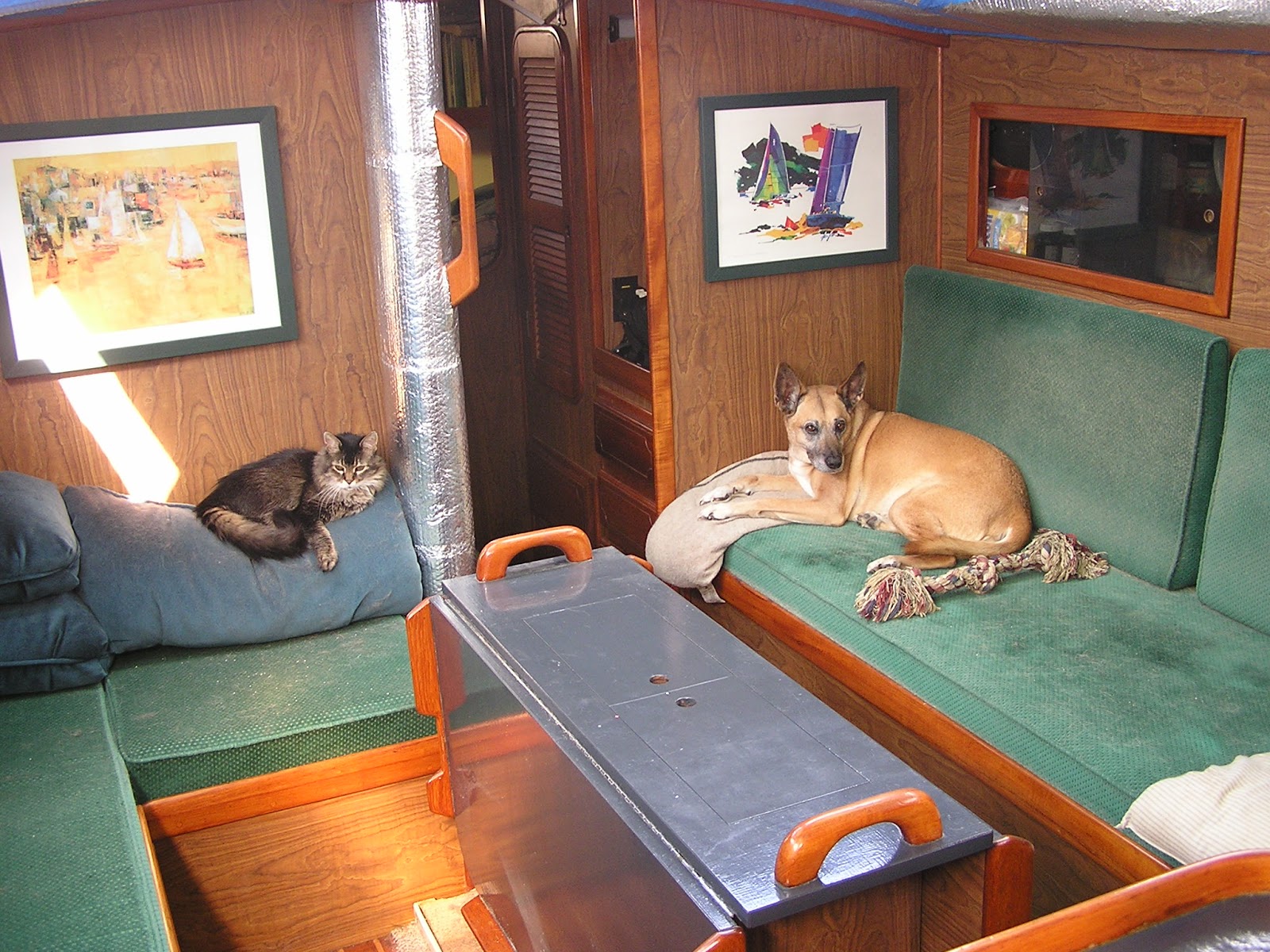
Another view of the mast.  Don't the pets look warm and relaxed?

The area around the nav station, and the louvers in the companionway drop boards were wrapped.

Overhead, too.  We didn't do the hatches because it would just be too dark.  A bonus; the silver reflected light and made winter less gloomy.

In addition to the silver, we used clear heat-shrink plastic meant to provide temporary insulation for house windows on the glazing.

Above the range.

We did every inch of hull!

The blue tape is 60-day painters masking tape.  It did pretty well in not leaving too much mess when we removed it.

More blue tape.  The whole project took about a week.

Lots of curves and irregular surfaces.

We did the insides of the lockers too.


In the v-berth, we used supports of plastic to keep the bigger pieces in place. Note the small electric heater on a shelf near our toes.  Toasty!


And outside, we built a frame of wood and PVC and draped plastic drop cloth.  We got a wonderful greenhouse effect on sunny days.

Here's the entire enclosed boat.  Bright and cozy, though we couldn't see out through the translucent plastic.


Antifreeze jugs half full of water held the edges down in the wind.

Here's part of the framework of PVC as we peeled the plastic back in spring.

More of the framework ...


We made the frame this tall so Dan could work on the deck during the winter.

Nautical version of a geodesic dome.


Thursday, August 29, 2013

s/v Rhapsody in Blue Delivery, Part 4 (of 4): Bittersweet

The final day of the trip dawned clear, warm, and calm.  The horn for the ferry docked just upstream of us woke us rather abruptly as it made its first departure from the dock at 6:00 AM, and we got underway early.  We headed out to sea with the falling tide giving us a fair-current boost, and turned north toward Georgia and our destination.

There was no wind, the ocean was calm and flat as we motored steadily.  The universe today was a very simple place.  But that calm gave us time for refection.  We had been so busy with the mechanics of getting the boat north, that we hadn’t really thought about what would happen when we got there. For Dan and me, it was a trip, a delivery, a job, and a chance to get to know some interesting people. But at the end of the day when we tied up at the dock, Rhapsody would have a new owner and Melissa would be temporarily homeless.

Dan and I sold our first home, a cute townhouse with an impressive view of Boulder, Colorado’s foothills, to a young woman for whom this would also be a first home.  Admittedly, it looked bleak compared to when she first saw it, now with all our rugs and furniture and artwork gone. She looked at the custom-made inset pantry and talked about bleaching the pine floors we’d installed, and asked how we could stand to part with our home. “But,” we said, “all the important stuff is coming with us.  Our friends, our memories, our pictures, our pets … what we’re leaving behind are just walls.”

“It’s a different kind of sheltering relationship with a boat, though, than with a house,” speculated Donna.  With a house, you somewhat take it for granted, because shelter is its only job.  In contrast, the boat shelters and protects you, but you also protect it.  You learn to understand its messages and needs (“trim my sail a bit, wouldja, it’s too loose and flagging, and I can get more speed from this wind;” “these waves are uncomfortable and if we keep bashing into them something’s gonna break, let’s turn about 15 degrees down and we’ll ride better and get there just as soon”) and that makes the relationship feel symmetrical, almost symbiotic, almost human.  Maybe this is also part of why boats are called “she” and not “it.”

I caught Melissa once or twice patting the mast reassuringly, giving the helm a little hug, and whispering “you’re a good girl” to the boat that had been her home, her teacher and companion in many sailing adventures.  They had grown together and had many good times and some tense ones, but now, like high school graduation, they were going on to new adventures … separately.

And like high school graduation, there was a sense of inevitability about it, and a sense that outgrowing this boat was a marker of success.  Because ultimately, Melissa had learned what she needed to learn from Rhapsody, but this boat was designed to be light and responsive in mild conditions; it wasn’t designed to be big enough or stout enough for her future plans of crossing oceans.

That didn’t make it any less bittersweet when the sea buoy and lighthouse for St Simons’ inlet came into view.  The wind that had been still all day, gently rose enough for one last spirited hour of sailing, Melissa at the helm one last time.  Then we were in the inlet, up the river, and there was the marina. Melissa docked gracefully in the wind and current – she knew this boat.  The broker met us at the dock to take our lines, and it was over.

Bittersweet Finale: Melissa's last sail at the helm of Rhapsody, on the way in to St Simons, GA.  Her new ocean-capable boat is currently getting its final touches at the factory and will be delivered next month.

Marking the End: the lighthouse at the inlet, St Simons, GA

s/v Rhapsody in Blue Delivery, Part 3 (of 4): Storms

Although we had planned a layover day in St Augustine, there was no “resting” involved.  Dan and Melissa hauled 2 carloads of possessions off the boat to her son Justin and daughter-in-law Jenny’s house, Donna and I did a lightning-fast tour of the Plaza, St George Street and Flagler College. That was enough, Donna said, to make her certain she wanted to come back and spend more time in the town.  Careful … that’s what happened to us too.  First time we passed through the town, we stayed for a day.  The second time, we were there for a week.  Then the third time, we stayed for the entire season, and we’re planning on being there at least through the holidays when we make our southward migration this year. (Do you see a trend here?) We brought Melissa’s outboard in for service, topped up the boat’s supply of water, visited Tony and Michelle’s lovely new-to-them historical house and Justin and Jenny’s newly-built house west of town, went out for a nice dinner, and prepared to get underway again early the next morning.  There was just two days’ travel to go.

The forecast was for storms, so we decided to run this leg “inside” on the ICW.  Staying inside gave us many options to tuck in to shelter whenever the sky looked ominous.  But it also meant that we were going to be motoring all day, no sailing in those narrow confines, and one of us would be driving at all times, guided to deep water by following a zigzag series of buoys.  Very different from the freedom of being in the open ocean and letting the autopilot and the sails do the work!

Remember that “boost” we got earlier in the trip, taking advantage of the Gulf Stream current?  Today, that bill came due.  Currents were against us all day, carrying us south as we motored north like going the wrong way on an escalator, robbing us of a knot or more of speed.  But with four of us taking turns driving, the trip was easy and the passing scenery interesting as the clouds continued to build.

By mid-afternoon the sky was ominous and gray and we were looking for a sheltered place to spend the night.  We made arrangements with a small marina a couple of miles ocean-ward of where the ICW crossed the St John’s River near Jacksonville, just an hour or two from where we were.  They also had fuel, which was useful since our slogging progress against the foul current had used more than we’d anticipated for the day.

Then began the heart-thudding race.  If my life were a movie, this is where they’d cue the suspenseful music in the soundtrack.  Melissa’s “marching elephants” were gathering and circling us, the skies were rapidly darkening, and the big boats were headed for the relative safety of open water, where they had room to run from the storm instead of risking being pushed aground.  We could see the safety of the marina we were headed for, barely a mile away, but the currents against us grew stronger and our forward progress slowed even more, like one of those running-in-place nightmares.  The gathering storm wasn’t slowing, though.  It was looking like we were going to get very, very wet.  As if that wasn’t enough adrenaline, the needle on the fuel gage was looking up at the bottom of the “E.”  Would we run out of fuel at any minute and, adrift in a river too deep to anchor and not enough wind to sail, be helpless in the storm?  (We later learned that we had fuel, but the gage was acting glitchy.  Too bad we hadn’t known this at the time.  It would have saved us some stress.  Some, but not all; those skies were scary-dark!  And later we learned just how scary: this was what Melissa called a “level 5” thunderstorm – that’s pilot-speak for really big almost off the charts nasty storm – that dropped 2-4 inches of rain in parts of Jacksonville, and a tornado touched down less than 5 miles from us according to NOAA's summary report of the storm [pdf].

We tied up with the help of two sturdy dockhands just as the first fat drops of rain were falling.  Another drencher like we’d had on the first night, this time with lots of wind as well.  But this time we were all snug and dry and secure.  Bad weather like that is almost fun, seen through a pane of glass. Good food and a fair amount of rum and laughter completed the evening, and if the laughter was a bit shrill with released tension and the impending end of the trip, well, who’s to blame us? [to be continued]


Heading north through the Bridge of Lions on a cloudy day.  Today is the only day of the trip we would be "inside" on the ICW instead of out on the Atlantic.

Gathering clouds in early afternoon.
We had just tied up in the marina near Jacksonville when the thunderstorm hit; here's what that same storm looked like from the anchorage back in St Augustine, about 35 miles away.  (photo by Heather Alsobrook)


Thursday, August 22, 2013

s/v Rhapsody in Blue Delivery, Part 2 (of 4): Company

We had made excellent time so far with the help of the Gulf Stream.  We were ahead of schedule and tired from the previous night's storms, so we opted to come in and anchor for a sound night’s sleep.  Besides, Melissa had had little experience anchoring with tides and currents while Dan and I had a lot; this was a chance to build that skill.  We could pass on our knowledge and reciprocate her help teaching us how to read thunderstorm clouds.

We called TowBoat U.S. for some local knowledge (information and guidance) on the inlet, since none of us had used it before.  Good thing we had -- there were some active dredging operations going on and the scene we saw on the river was very confusing.  Markers had been moved or removed compared to what was on our chart and the the water was scattered with buoys,  barges, and pipes.  The hints from the towboat guy were spot-on, and by following them, it was pretty straightforward coming in, and a short distance to the anchorage we’d selected.  But when we dropped the anchor, instead of swinging to the wind as a boat at anchor would normally do, the boat sat sideways.  Melissa was baffled, and assuming the anchor had failed to set, quickly raised it to try again, with the same result.

Current was to blame.  Water being far denser than air, the current was pushing the boat with far more force than the wind, so the boat was lying to the current, which was uncomfortably for us, exactly crosswise to the wind.  One of Dan’s Navy colleagues once told us that depending on the shape of the boat and the keel, it can take 20 or 30 knots of wind to overcome one knot of current in determining the direction a boat at anchor will point.  This was one of the cool things about the trip – the four of us came from different sailing backgrounds and experiences, yet each one of us taught at least one new thing to each of the others, and learned something from each of the others.  What I love about sailing – easy to learn, but impossible to master.  There’s always something new to challenge and delight you, and room to grow.

Melissa, Donna, and I had all first met online, so it’s not particularly surprising that our evening consisted of some Internet time along with an excellent dinner.  In an amazing coincidence, I checked Facebook only to discover that our friends Tony and Michelle had just crossed the Gulf Stream as they returned  from the Bahamas with their boat A La Mer (“to the sea” in French) … and had come in the same inlet that we had and were tied up no more than a mile from us. Our plans were to spend a day St Augustine where Melissa would offload most of her personal possessions from the boat to store with her son and daughter-in-law who lived there. Tony and Michelle also lived in St Aug and were bringing their boat to a mooring there, so we quickly made plans to sail together the next day.

And that next day was the one that will stand out in my memory as the perfect day on this trip.  We sailed blue water on pleasant breezes, and had company both human and aquatic.  Dolphins played in our bow wave, then hurried over to play with Tony and Michelle.  There were sea turtles, manatees, and (maybe) a distant whale.  We took pictures of A La Mer under sail, and they took pictures of us.  By midafternoon we saw the St Augustine lighthouse on the horizon, and a few hours later we were waiting for the next opening of the familiar drawbridge.  A few hours after that, we were at the familiar (oops, maybe a bit too familiar to us?) alehouse across the street from the marina. [to be continued]

The ligthouse at Ponce de Leon Inlet

A quiet anchorage ... we had it all to ourselves


Our dolphin escorts putting on a show for us (photo by Donna Ferron)

Dolphins bring out the enthusiasm in all of us.  Melissa getting a closeup dolphin photo and video.
Exuberant!

Our friends' boat A La Mer, homeward bound.
Waiting to come through the Bridge of Lions

Chillin' out at the end of this part of the journey, at the A1A alehouse across the street from the marina with Heather, Syd, Tony, Michelle, Kristopher, me, Grace, and Dan.  Melissa and Donna stayed at the boat to meet up with her son Justin and his wife.