Monday, April 18, 2016

Blogging from A to Z: One Square Mile Living (Oh the Irony!)


During the month of April last year, I participated in the A to Z Blogging Challenge - one alphabet-themed post per day (except Sundays).  I had such a good time with it that I'm doing it again this year.  I'm loosely organized on the theme of downsizing, minimalism, and small-home living that I've learned in 14 years of living on a small boat.  I'm starting with A is for Anchoring Out, Anger-ing Out, and ending with Z is for Zout and Zwarte Peper (Dutch for salt and black pepper). Click on the A to Z logo on the lower left sidebar for links to many other bloggers participating in the challenge.

A little more than one square mile around our present home marina (image modified from Google Maps)
There were 3 separate periods in my life when I drove more than an hour each way, each day, from home to work. In all 3 cases, I had an awesome job and lived in an awesome location, and didn't want to give up either one. So I drove. A lot. I remember hating how spread out my life was, and how little time I had to actually enjoy my home town, and wanting to literally "get my life together" by getting everything in one place. Wouldn't it be wonderful if everything we needed in life, school, work, shopping, home, play, was all within close proximity?

There was lots of talk about "one square mile living" around that time. Of course, this describes any downtown of a big city ... but I don't really want to live in, say, Manhattan. (BT, DT, no thanx not again). There are also new planned developments that had shops and offices and restaurants on the ground floor, and apartments above, you could walk to everything and didn't need a car.  Truly, one-square-mile living. Everyone, it seemed, was hopping on the small-footprint bandwagon, except us. I drove about an hour and a half north from our home to my job, and Dan drove about an hour south.  Sigh. We'd occasionally declare a car-free day one weekend day, enjoying the novelty of being no further from home than walking distance for 24 whole hours.

Fast forward to retirement and cruising, and finally had the opportunity to do the one-square-mile-living thing ourselves.  Had to, in fact, since we couldn't very well have a car as we sailed the boat from place to place. We found ourselves drawn particularly to smaller historic port towns -- Annapolis, Beaufort, Southport, St Augustine. Walkable by their very nature; they were all laid out before the invention of cars. Although we truly didn't need a car, we'd rent one every few weeks just for the weekend, to run errands conveniently, and to explore the surrounding areas. The irony? Now that I have that, and we've been car-less for going on 4 years now, I'm longing for wheels again, for roaming more widely.

"Be careful what you wish for, you may get it." Indeed!

Sunday, April 17, 2016

Blogging from A to Z: N is also for Net-less

Apologies for not getting back promptly on comments; we are having internet issues here at the marina.  Will write in as soon as I have better net!

Blogging from A to Z: N is for Nautical Priorities (Litmus Tests)


During the month of April last year, I participated in the A to Z Blogging Challenge - one alphabet-themed post per day (except Sundays).  I had such a good time with it that I'm doing it again this year.  I'm loosely organized on the theme of downsizing, minimalism, and small-home living that I've learned in 14 years of living on a small boat.  I'm starting with A is for Anchoring Out, Anger-ing Out, and ending with Z is for Zout and Zwarte Peper (Dutch for salt and black pepper). Click on the A to Z logo on the lower left sidebar for links to many other bloggers participating in the challenge.

(image from here)
Back in the 1990s, the buzz in corporate America was "mission statements." Developing a mission statement for our unit was a requirement in one of my leadership classes. And while I thought it was more than a little hokey, I went through the exercise anyway. I was the supervisor of a group of scientists doing environmental research, and my final mission statement was something about creating an environment where people were inspired to do excellent science that was valuable to our agency and the scientific community and the general public and blah blah blah. I distributed funds and assigned work and approved hires, and I was also a bit of a buffer, insulating the scientists from the incessant adminis-trivia imposed on us by the bureaucracy.

Something interesting happened along the way, though. Having this statement written out led me to a super-easy litmus test benchmark for all kinds of decisions about where to invest resources for my group. Subscription to a pricey journal? Will it help them do better science? New piece of lab equipment? How about preparing that annual report on our activities for Headquarters? Should we spend a lot of energy on it, or just do a bare minimum job? Every one of these questions became a very simple yes/no, when seen through the lens of whether it would help them do better or more valuable science.

That lesson, of having a litmus test that simplified decisions, carried over perfectly in our downsizing and our life afloat. On land, our house on its better days adhered to the William Morris dictum, "Have nothing in your house that you do not know to be useful or believe to be beautiful," although "beautiful" in our case was expanded to also encompass the beauty of items that had sentimental meaning even if their aesthetic was lacking.  I suppose that making us smile wistfully when we looked at them and remembered how they came into our lives, was both beautiful and useful!

In our radical downsizing to move aboard we overlaid a second litmus test onto the Morris one. This one came to me courtesy of cruising friend Linda G.  When deciding what to bring aboard, she advised, your priorities should be: first, safety; then tools; then "everything else." It was a simple, effective hierarchy.

During the hectic years of getting ready, living aboard at a marina, working at conventional jobs during the day and doing boat projects in our not-so-spare time, we developed a third litmus test. This one was, "If it doesn't make the boat safer, or sail better/faster, it's a lower priority." So the early times involved a bigger anchor, new engine, and oversize windlass. It was only much later that we got around to things like painting, and converting the icebox to actual refrigeration.

Now that we've got the boat pretty much the way we want it, projects are just regular maintenance (although there's always some cool shiny piece of newly-invented gear to covet).  Our priorities litmus test is more about what we want to do with our lives than what we need to do with the boat. It's simple, and it was also my New Year's resolution: Be together. Be happy. Have more adventures.

Friday, April 15, 2016

Blogging from A to Z: M is for Minimalism

During the month of April last year, I participated in the A to Z Blogging Challenge - one alphabet-themed post per day (except Sundays).  I had such a good time with it that I'm doing it again this year.  I'm loosely organized on the theme of downsizing, minimalism, and small-home living that I've learned in 14 years of living on a small boat.  I'm starting with A is for Anchoring Out, Anger-ing Out, and ending with Z is for Zout and Zwarte Peper (Dutch for salt and black pepper). Click on the A to Z logo on the lower left sidebar for links to many other bloggers participating in the challenge.

This idyllic cabin belonged to Teddy Roosevelt (image in public domain,By Podruznik at English Wikipedia - Transferred from en.wikipedia to Commons by Feydey using CommonsHelper., Public Domain, https://commons.wikimedia.org/w/index.php?curid=7826516)

"Some people want a big house, a fast car, and lots of money. Others just want a small cabin in the woods away from those kinds of people." So goes the internet meme, and we count ourselves among the people who want the cabin in the woods ... or in our case, boat in an anchorage.

Way before minimalism was cool, we found we had to design a minimalist lifestyle simply to fit into our new maritime world.  We have fewer possessions and spend less money on "things" partly as a conscious choice to free up more of our time and respect the environment, but also of necessity.  We have so little storage space, we had to figure out what "just enough" of everything looked like. We learned that the fewer things you have, the more you value each one. I experimented with having 33 items of clothing instead of a closet full -- and of course, none of them need to be ironed or dry cleaned.  We have room for a decent collection of hand tools, but we no longer have a full woodshop. And if you come over for dinner we'll serve you healthy tasty food, but you'll be eating it off of Corelle plates and drinking your wine from plastic wine glasses -- we won't be impressing you with table service of breakable crystal and china, though we value your company.

The real attitude adjustment, though, was realizing that a simple life isn't necessarily an easy one. Heating our suburban house took a simple turning of a dial or pressing a button; heating the iconic cabin in the woods probably requires hours of work splitting and stacking logs. Simple, not easy.  So too on our boat -- those memorable moments in that pristine anchorage require the navigation and timing of the tides and reading the weather, and leaving may require raising a heavy anchor and washing the mud off the chain. (Luckily we've now got an electric windlass to handle this task!)  And since we're carless, because how could you move a car from island to island, we walk, bus or taxi everywhere ... slowly. That also requires additional logistics -- how will I get my purchases home if they are heavy, or if it starts to rain?  Simple, not easy.  Getting anything out of a locker or putting it back involves a 3-D game of Tetris as we negotiate efficient use of our limited storage space. Without space or water supply or sufficient electricity for washing machine or dishwasher that get things clean with a push of a button, we do those tasks by hand as well, which takes a lot more time and work.  Simple, not easy.

Putting in that effort, though, makes things feel more valuable, more focused.  Dan, working with a chef's knife, gets into a rhythm he calls the "Zen of vegetable chopping" that is unachievable  with a food processor. Our recreation often consists of sitting in the cockpit reading, or paddling our inflatable kayak or going for walks or dinghy rides. Of necessity, this life is slower, and each task fills our minds as we do it. Simple, not easy. And we wouldn't have it any other way.


Thursday, April 14, 2016

Blogging from A to Z: L is for Leaving ... on a Jet Plane

During the month of April last year, I participated in the A to Z Blogging Challenge - one alphabet-themed post per day (except Sundays).  I had such a good time with it that I'm doing it again this year.  I'm loosely organized on the theme of downsizing, minimalism, and small-home living that I've learned in 14 years of living on a small boat.  I'm starting with A is for Anchoring Out, Anger-ing Out, and ending with Z is for Zout and Zwarte Peper (Dutch for salt and black pepper). Click on the A to Z logo on the lower left sidebar for links to many other bloggers participating in the challenge.

For the times that traveling by sailboat is impractical (NASA image from here)


This is a blog about boating ... so why am I writing about airplanes? Dan and I sail in order to travel (on a budget), and while being on the ocean is an extraordinary experience, we are travelers first. Traveling by boat, for us, enhances the experience in many ways, as I wrote in a previous post in this blog:
...we like to visit fewer places, more deeply.  Stay long enough to really understand what makes a place special, what unique solutions the people who live there have discovered to ease the problems of everyday living.  Traveling by boat gives us the platform for that travel in a way no other kind of transportation could offer.  It lets us visit places literally “without leaving the comforts of home” because our home, turtle-like, comes with us.  It lets us visit these places on a budget.  And, when we’re tired of cities and civilization and people, it lets us get away and recharge close to nature.  (Sometimes, during storms, a little too close, as “nature” splashes over the deck or whistles in the rigging!) My absolutely favorite benefit of boat travel, though, was completely unexpected.  Explaining that we live this quirky life is a never-fail conversation starter with just about everyone we meet, whether they’re other cruisers or total landlubbers, travelers by more conventional means or homebodies.

Still, there are a lot of logistical considerations that make traveling by sailboat far from our only option.  Some destinations are impractical to reach by sailboat in a reasonable timeframe, or would take too long to reach to be practical given the amount of time we'd like to stay there. Or they involve passages unsuitable for this sailboat; while our boat is physically capable of crossing the Atlantic, it would not be the wisest choice for that trip.  For one thing, we don't have the capacity for enough food, fuel, or water to make what would likely be a month-long voyage. Some passages would be unsafe given the season that we want to visit the destination.  Some destinations on our someday list are downright impossible to visit by sailboat -- they have no ocean frontage!

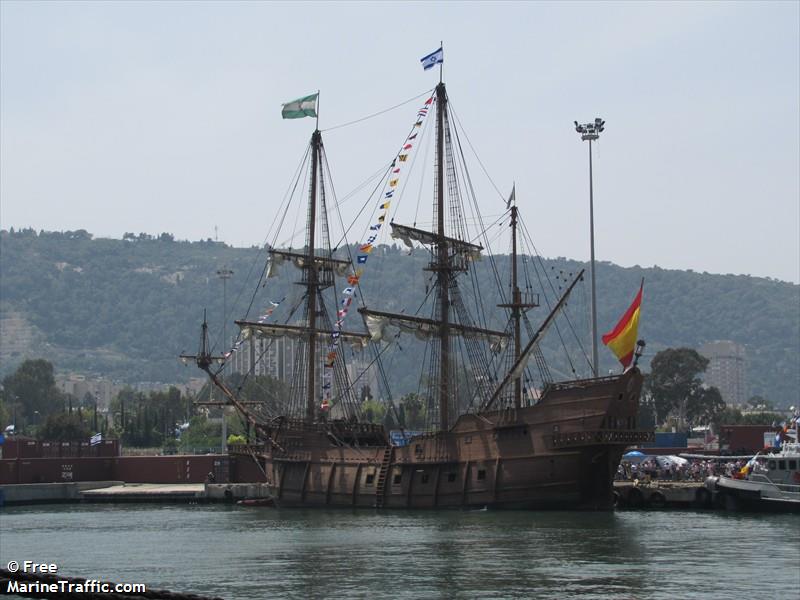
Most importantly, we've learned from multiple trips that about 3 months is our preferred away-from-home limit. That could be 3 months out of country on our boat, as we did when visiting the Bahamas on our first cruise,or 3 months away from the boat, as we did last summer on El Galeon, or when we lived in a townhouse for the winter with our boat docked a few miles away.

Initially, we expected to sail away forever when we retired.  After all, we have neither dependent parents, nor dependent children, no dogs, cats, not even houseplants to bind us.  Why not spend forever in a tropical paradise? That expectation came before we learned about our 3-month limit. It came before some significant health scares. And we learned that we didn't want to live exclusively on tropical islands any more than we want to live exclusively anywhere -- the world is just too big, there are too many things we want to experience. Tropical islands forever are just too claustrophobic, and I'm not all that great at languages, I don't like thinking about hurricane season.  We've been through 3 hurricanes aboard and two more ashore nearby our boat, and I'd be delighted not to experience another any time soon. Finally, and happily, some old financial decisions worked out in our favor, and the budget is not quite as tight as we thought it would be.

At this point in our lives we've evolved to make our peace with becoming what Stephanie in her blog SV Cambria describes as regional cruisers, in our case along the US East Coast, at least when traveling in our own boat. Visiting the nooks and crannies and back roads and undeveloped anchorages, spending a month or two in an area and then moving on, when it would only take a week or two (anchoring at night) or passages of only a few days (sailing through the night) to get to a new state, sounds delicious.  For farther-away destinations, there are hotels and rental apartments and jet planes.


Wednesday, April 13, 2016

Blogging from A to Z: K is for Kickback (and, Kickin' Back)

During the month of April last year, I participated in the A to Z Blogging Challenge - one alphabet-themed post per day (except Sundays).  I had such a good time with it that I'm doing it again this year.  I'm loosely organized on the theme of downsizing, minimalism, and small-home living that I've learned in 14 years of living on a small boat.  I'm starting with A is for Anchoring Out, Anger-ing Out, and ending with Z is for Zout and Zwarte Peper (Dutch for salt and black pepper). Click on the A to Z logo on the lower left sidebar for links to many other bloggers participating in the challenge.

Jus' kickin' back -- photo by Mike Baird via Wikimedia Commons


When I worked in government contracting for the Army in Colorado, kickbacks were a very bad thing.  If you google "kickback" you will find it is "a payment made to someone who has facilitated a transaction or appointment, especially illicitly." In other words, taking a bribe to make a decision about awarding a contract that may not be to the best candidate, and not in the best interests of the taxpayer whose dollars you are spending.  Illegal. Jail-able.

The kind of kickback I want to do today, though, is different.  I want to kick the limelight back onto some of the other blogs I've been enjoying at this point nearly halfway through the A to Z blogging challenge.  And I also want to enjoy the other meaning of the word "kick back" -- put my feet up and relax about generating thoughtful blog content today.

Shoutouts to my fellow boating bloggers in A to Z Challenge:

SV Cambria - Blogs from the Boat
The Cynical Sailor and his Salty Sidekick
The Larks of the Independence
Till the Butter Melts

And a few other simplicity/minimalist/alternative life blogs in the Challenge that I'm enjoying:

Quietude Road
Roaming About: A Life Less Ordinary
Second Thoughts First
Pain-Passion-Purpose

And a couple of blogs about things I never knew anything about about before the Challenge:

Counterweight Press
The Multicolored Diary
Finding Eliza

Just fun-to-read:

WordSplash
The Girl Who Wrote It All Down
Lissa Johnston
Working in Words


Tuesday, April 12, 2016

Blogging from A to Z: J is for the Joneses

During the month of April last year, I participated in the A to Z Blogging Challenge - one alphabet-themed post per day (except Sundays).  I had such a good time with it that I'm doing it again this year.  I'm loosely organized on the theme of downsizing, minimalism, and small-home living that I've learned in 14 years of living on a small boat.  I'm starting with A is for Anchoring Out, Anger-ing Out, and ending with Z is for Zout and Zwarte Peper (Dutch for salt and black pepper). Click on the A to Z logo on the lower left sidebar for links to many other bloggers participating in the challenge.


Who are the Joneses, and why are we trying so hard to keep up with them? The phrase "keeping up with the Joneses" refers to comparison with your neighbor as a benchmark for social status.  And the way it leads to a materialistic arms race of conspicuous consumption -- big house, shiny car, designer clothing, exotic vacations, on and on and on -- as people confuse cause and effect.  It's a great advertising scam -- if I buy the fancy things, that will give me the higher status.  As Will Rogers put it back in the 1960s, "Too many people spend money they haven't earned to buy things they don't want to impress people they don't like."  There's a corollary, too, that you don't know if the Joneses' life, that looks so glamorous from the outside, is actually happy on the inside. They could be broke.  But when we lived in suburbia, it was definitely a thing, that nearly inescapable competition.

When we first moved onto the boat, we hoped we were done with that.  But we found that "keeping up with the Joneses," or at least, making assumptions about peoples' status based on outward appearances must be a human nature, because the maritime variation of that theme is all around us.  Its neither better nor worse than the suburban version, just ... different.  To a certain extent, people group themselves by boat type -- although we all are doing this because we love the sea, people in small fishing boats meant for day use or maybe a weekender are not going to have that much in common with the goals of people who are in the process of traveling around the world by sailboat, and someone in a 100-foot shiny megayacht is probably not going to talk to the likes of us. Unlike the hypothetical Jones family in suburbia, where outward appearances don't necessarily give a true picture of the real condition of their quality of life, the different boat types in the marina give a pretty good indication of the owners' priorities and plans -- and the size and age of the boat is a good proxy for finances.

In some ways, in a marina the Joneses comparison is even more in-your-face than it is in suburbia.  Neighborhoods tend to be at least somewhat homogeneous and houses within them are similar in cost; it's rare to find an old cottage or bungalow next to a McMansion. In a marina, the boat docked in the slip next to you may be new and glossy or one step away from sinking, fast or slow, power or sail ... and may be sailing away again tomorrow.

Where we finally did escape the keeping up with the Joneses, was when we started cruising, actually traveling around by boat. In an anchorage, no one ever asks you what do (or did) for a living.  Many of our boat friends, we don't even know their last names, they are just first name, boat name: "Joe and Sandy on Windswept." There is almost a reverse status thing going on: the only "keeping up with the Joneses" we encounter is how far you've traveled, and often the older, sea weary boats earn more prestige than the new shiny ones with wealthy but inexperienced owners.


Monday, April 11, 2016

Blogging from A to Z: I is for In The Beginning


During the month of April last year, I participated in the A to Z Blogging Challenge - one alphabet-themed post per day (except Sundays).  I had such a good time with it that I'm doing it again this year.  I'm loosely organized on the theme of downsizing, minimalism, and small-home living that I've learned in 14 years of living on a small boat.  I'm starting with A is for Anchoring Out, Anger-ing Out, and ending with Z is for Zout and Zwarte Peper (Dutch for salt and black pepper). Click on the A to Z logo on the lower left sidebar for links to many other bloggers participating in the challenge.

Beginnings are such wonderful times! (image from freeios)


Dan grew up on a wheat farm in landlocked southwest Kansas. Jaye's parents met cute at the beach, but rarely took their children there. We met when we were living in landlocked Colorado and were more intrigued with mountains and snow than oceans.  So how the heck did we end up living on a sailboat?

Like many paths in life, the journey incorporated a combination of taking advantage of spontaneous opportunities and structured planning.  The beginning was all spontaneity. At the time, Dan had a kitchen and bath design/remodel business and Jaye worked in an office. One of her colleagues approached her to ask if Dan could replace the countertop on a small sailboat.  We now refer to this as "the most expensive job we ever did."

The project was quick and easy -- so quick in fact, that when the colleague asked for the bill, Dan said "Hey, you know, this was such a small job its almost embarrassing to bill for it.  Tell you what. I've got about 3 hours labor in this; why don't you give us three hours on your sailboat in return and help us understand why you enjoy this so much?"

One lovely Saturday we drove to Lake Granby in the Rocky Mountains northwest of Denver where the colleague kept his boat. We sailed for a bit, dropped anchor and had lunch (for some weird reason I still remember that we brought homebaked rolls filled with chopped mushrooms), sailed some more, and returned to the mooring.  And that was all it took. Dan was utterly, completely hooked.

Six months later in the snowy winter, Jaye's office mate was hosting a candle party.  Also attending the party was the office mate's best friend, who was a charter yacht broker representing boats in the Virgin Islands. A tropical vacation sounded really good right about then, so next thing we knew, we were booked on a one-week liveaboard/learn to sail cruise.

Sailing our first boat on a light-air Lake Michigan summer day


The rest of the transition was more about planning than the initial luck, except that once we started, things seemed to come our way a bit faster than we expected.  An opportunity came up to move to Michigan (lakes! big water for sailing!) and three weeks after we arrived we bought our first sailboat, a 1975 Erickson 27 named "Bassackwards." We weren't crazy about the name but vowed not to change it until it no longer accurately described our sailing skill.  We kept it on a mooring in Northport and left home every summer  Friday afternoon at 3 PM for the drive to the boat, staying aboard, practicing our sailing skills and escaping our city lives, returning late in the evening on Sunday.  We never did get around to the name change; a few years later we were able to trade up to our far more liveaboard friendly current boat instead.  Hadn't planned on buying it so soon, but a good enough deal came up that we just couldn't pass it by.

 Fast-forward 4 years and we were relocating again (not entirely by choice) to Headquarters near Washington, DC. We quickly learned that even with a cost-of-living differential, we weren't going to be able to maintain our former standard of living -- what we had paid for a three-bedroom house on the river would about cover a studio apartment with a view of a brick wall.  What to do? Well, we were going to have to find a place for the boat anyway, right? And, we were planning to move aboard anyway someday, right? Why not just save the money we would be paying on rent, and accelerate our plan to move aboard right now? It would take some frantic downsizing, and a rather longer commute than I preferred, but indeed, why not?

Saturday, April 9, 2016

Blogging from A to Z: H is for the Horizon

During the month of April last year, I participated in the A to Z Blogging Challenge - one alphabet-themed post per day (except Sundays).  I had such a good time with it that I'm doing it again this year.  I'm loosely organized on the theme of downsizing, minimalism, and small-home living that I've learned in 14 years of living on a small boat.  I'm starting with A is for Anchoring Out, Anger-ing Out, and ending with Z is for Zout and Zwarte Peper (Dutch for salt and black pepper). Click on the A to Z logo on the lower left sidebar for links to many other bloggers participating in the challenge.

Looking forward to a calm night at sea on El Galeon


"A ship in a harbor is safe, but that is not what ships are for," reads one of my favorite quotes. It's a perfect blend of realism and bravado. Indeed, the feeling that we get when putting our stern toward land and sailing directly away toward the open ocean horizon is indescribable -- nervousness and wonder, paradoxical stress at what could go wrong (and what, maybe, we forgot to do) and anticipation of the relaxation that comes when we give ourselves to the timeless rhythms of the sea. Reliant only on ourselves and our little boat, an ocean trip is totally different from a trip parallel to the coast or up the ICW, where we are never out of sight of humanity and its constructions -- and rarely more that a few hours away from help or safe harbor to tuck into. (And BTW, even the galeon is a little boat, any boat can be a little boat, in the wrong sea conditions!)

There is scientific evidence for the existence of a "wanderlust" gene, and that makes evolutionary sense; the people who wander when resources are scarce may be more likely to find new resources, and hence survive. Of course, it's also possible that they could run into danger and not survive, but it was also absolutely certain that if they just stayed where they were, they would keep getting what they already had gotten (presumably insufficient).

For us in 21st century America, thankfully, resources like food and water are not scarce. But still, the wanderlust gene kicks in.  This time around, it's not survival resources that we wander in search of. With few possessions to weigh us down and a boat-home to take us places, we seek other intangibles -- new ideas, experiences, friends, outlooks.  Adventures.  Bring me that horizon!

Blogging from A to Z: G is for Galley Gadgets

During the month of April last year, I participated in the A to Z Blogging Challenge - one alphabet-themed post per day (except Sundays).  I had such a good time with it that I'm doing it again this year.  I'm loosely organized on the theme of downsizing, minimalism, and small-home living that I've learned in 14 years of living on a small boat.  I'm starting with A is for Anchoring Out, Anger-ing Out, and ending with Z is for Zout and Zwarte Peper (Dutch for salt and black pepper). Click on the A to Z logo on the lower left sidebar for links to many other bloggers participating in the challenge.

Overview of the galley.  It's about 4 feet wide by 5 feet long.
Our galley, though extremely efficient in layout, is really tiny by land standards. For storage of items other than food we have two shallow drawers plus two cabinets, the larger of which is about the size of the half-cabinet above a sink or stove in a kitchen on land.   One cabinet holds all the cups and plates and wineglasses; the other plus the two drawers hold all our cookware and gadgets. 

That's not much space, so everything has to be chosen based on its ability to earn its keep.  We have several criteria:

  • It has to serve multiple purposes -- we don't have space for fancy items that only do one thing.
  • Within reason, it has to be the smallest thing that will do the job.  Stackable or collapsible is a bonus.
  • It needs to be able to operate without electricity when we are underway or at anchor. The only exception is our immersion ("stick") blender, which operates on 12-volt ship's power.
  • Breakable glass or inexpensive metal prone to rust are to be avoided whenever possible.


Oh yeah, and we love to cook and explore new foods, so within those constraints we have to have all the tools that will let us be able to play in the galley.  No waffle irons or popcorn air-poppers or even bread machines or Kitchenaid stand mixers; they take lots of space, each do only one thing, and need to be plugged into electricity.  Instead, here's a whirlwind photo tour of what we do have.  By some standards, it's "camping." And each individual has to pick what they personally don't want to do without and figure out how to accommodate that, or it will feel like camping.  Your list will not look like mine.

The big surprise is that far from feeling limited by not having all those modern conveniences ("mod-cons") and specialized cool tools that every cooking store and catalog touts, with our limited hand tools we're being forced to pay attention to the details, handling each vegetable, living slow, and we've developed a much more intimate relationship with our food than we ever expected. We're having more fun, without all those gadgets, than we ever did with them. (Except the homebrewed beer stuff.  Gotta admit, I still miss that.)


This is the cabinet on the right side of the galley, with everything stowed and nested compactly.
The same stuff as in the photo above, spread out! Four nesting saucepans in varying sizes, and the larger fry pan, all share the same detachable handles.  Plastic lids for the pots (minus handles) allow for easy storage of leftovers or bringing food to a potluck.  There's also a pressure cooker that these pans all fit inside, and another smaller frypan.  Nesting plastic mixing bowls with lids, collapsible silicone colander, vegetable steamer, sieve, potholders, and trivets. 

A closer look at the nesting pots.

Probably the most important tool in the galley -- coffee! Heat water in a teakettle on the stove, and pour it through grounds in the gray filter-holder on top.  

The filter holder is silicone; it scrunches down and stores in the pitcher when not in use.

No kitchen is complete without a good set of knives! These live in a leather holder custom-made and tacked to the side of the dish cabinet.

The knives live in this leather holder tacked to the side of the dish cabinet


Essentially the only powered tool in the galley -- battery operated immersion blender for soups and our morning smoothies.
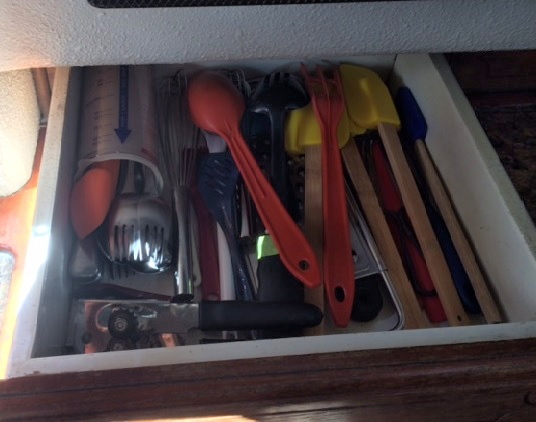
One of two gadget drawers.


Things from the drawer above: I've got a bit of a silicone spatula fetish!
More things from the drawer above: flat cheese grater works just as well as box grater while storing more efficiently. Flatware and measuring spoons store in (plastic) measuring cup; wire whisks for sauces, and the all-important wine opener!
A few gadgets from the second drawer: old-fashioned egg beater, potato masher, pie-crust maker, lemon zester, jar opener, thermometer, and military-style P-38 can opener (we don't use this anymore; it was tucked into a corner of the drawer slightly rusty, and that's a story for a future post)


This is one of those single-purpose items I mentioned; why do you need a special tool (that can do nothing else) to slice hard-boiled eggs when a plain old knife works just fine? And that is why, this tool is still on the rack at the store instead of in our drawer!
Just a couple of things didn't make it into the photos: a teakettle, cutting board that doubles as a sink cover to extend counter space.  We do have an oven, but it's only a little bigger than a toaster oven.  For that, we have an 8x8 square glass baking dish the handles most of our baking, and pie pan for the rest, and 4 mini-loaf pans.  We use the latter to make individual lasagnas, a cute serving idea when full-size lasagna pan just won't fit.