Showing posts with label living aboard. Show all posts

Wednesday, April 27, 2016

Blogging from A to Z: V is for Virtual Privacy


During the month of April last year, I participated in the A to Z Blogging Challenge - one alphabet-themed post per day (except Sundays).  I had such a good time with it that I'm doing it again this year.  I'm loosely organized on the theme of downsizing, minimalism, and small-home living that I've learned in 14 years of living on a small boat.  I'm starting with A is for Anchoring Out, Anger-ing Out, and ending with Z is for Zout and Zwarte Peper (Dutch for salt and black pepper). Click on the A to Z logo on the lower left sidebar for links to many other bloggers participating in the challenge.

When we tell people we've lived together on a 33-foot boat for the last 14 years, they often ask how all that togetherness affects our relationship. Actually, I reply, it makes it better, since we really get in sync with each other's moods. But still, we are two strong individuals, and sometimes we need space. On the one hand, we've got the entire outdoors to get away in should we need to.  On the other hand, sometimes the space you need is more psychological. There are two essential tricks we use to give each other that.

No shoulder surfing!

We can’t give each other physical privacy, but we can respect each other’s mental space with “virtual” privacy, courtesies familiar to any cubicle dweller. No shoulder surfing or reading each other’s drafts without permission. (It helps to have illegible handwriting!) No commenting on overheard cellphone conversations (or *bathroom noises.*) Of course you heard it, but you pretend you didn’t, and don’t comment unless invited.

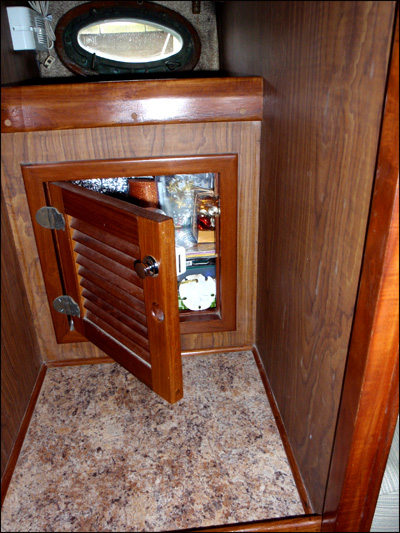
There’s very little discretionary space aboard the boat. Once we’ve filled the lockers with food and tools and safety gear there’s not a lot of room left over for personal gear (clothing and hygiene) and even less for toys. Still, although almost all the lockers are communal property, each of us has a personal locker that the other doesn’t access. We call it the "don't ask, don't tell" locker.

My private DADT locker, full of seashells and sentimental keepsakes and sparkly things

In mine, I can store frivolous items like collected beach glass and seashells, silly sentimental keepsakes, or the pastels that I keep thinking I’ll miraculously acquire the talent to put to good use, and Dan doesn’t get to comment on how that precious storage space could be put to better use storing something that will, you know, actually serve a purpose.

In Dan’s he can also store, without comment … um, I have no idea what he stores there. That’s the entire point of a DADT locker.

Those two very simple solutions have worked for us, and set up our expectations for when we summer as crew on El Galeon, where each person's private space is just one bunk shielded by a green curtain.

El Galeon crew dorm for sixteen. I can do this!

Parts of this blog post appeared previously in Women And Cruising blog.  To read the original go here.


Friday, April 22, 2016

Blogging from A to Z: R is for Rebaselining


During the month of April last year, I participated in the A to Z Blogging Challenge - one alphabet-themed post per day (except Sundays).  I had such a good time with it that I'm doing it again this year.  I'm loosely organized on the theme of downsizing, minimalism, and small-home living that I've learned in 14 years of living on a small boat.  I'm starting with A is for Anchoring Out, Anger-ing Out, and ending with Z is for Zout and Zwarte Peper (Dutch for salt and black pepper). Click on the A to Z logo on the lower left sidebar for links to many other bloggers participating in the challenge.


"I'm going to be offline next week," my friend Jorge told me. "I'm going on vacation and I'm so jazzed -- we're going to be on a liveaboard sailboat, we'll sail to a different island every day and we can just jump off the stern to go scuba or snorkeling."

"But Jorge," I had to chuckle, "you've just described my everyday life! When I go on vacation, I want to live on land, in a fancy resort, with a big shower, and a car."

In business management, rebaselining refers to adjusting project status when a project is delayed or external conditions have changed so much that the original timeline is no longer feasible. (definition from here) Adjusting expectations when external conditions change is also a feature of long-time living aboard. Our life afloat is rich in luxury for the spirit, not so much for luxury of the body.

It's actually been kind of cool, as we've developed a new appreciation for ordinary things. Our shower is the size of a phone booth and fresh water very limited so we do water-saving "Navy showers" -- turn the water on, wet your body, turn the water off, soap up, turn the water on, rinse off. In fact on the Galeon at sea, showers were with sea water, and each crew member was rationed one gallon of fresh water in a plastic jug for final rinse off. So now, a long shower in a big shower stall, with sit-down space and all the hot water you want, is my version of a spa day. And the odd thing is, it gives me just  as much pleasure as a spa would have when we lived on land ... because in each case you appreciate whatever is more luxurious than your baseline. Adjust the baseline, and it takes such little, ordinary things to make a big impact. We have a small freezer aboard, but in order to keep it cold enough to keep ice cream we would use an inordinate amount of power. So instead of being something we can grab whenever we want, ice cream becomes a special, infrequent treat to savor when we're in a new port.  Same is true of fast internet, washing machine, walk-in closet, all sorts of mod cons. Amazingly, doing without these things on a regular basis has increased our happiness -- because such small things now make us happy.

Thursday, April 7, 2016

Blogging from A to Z: F is for F. A. Q.s, Flat-Surface Syndrome, and Favorite Things About Living Afloat

During the month of April last year, I participated in the A to Z Blogging Challenge - one alphabet-themed post per day (except Sundays).  I had such a good time with it that I'm doing it again this year.  I'm loosely organized on the theme of downsizing, minimalism, and small-home living that I've learned in 14 years of living on a small boat.  I'm starting with A is for Anchoring Out, Anger-ing Out, and ending with Z is for Zout and Zwarte Peper (Dutch for salt and black pepper). Click on the A to Z logo on the lower left sidebar for links to many other bloggers participating in the challenge. 


What kind of boat is Cinderella?
Cinderella is a 33-foot Caribbean Sailing Yacht (CSY).  Built in Tampa, FL in 1980 for the charter trade, they have a reputation for being both elegant for their day, and very sturdy.  We have owned the boat since July 2000 and lived aboard full time since November 2002.  We lived in a marina in Annapolis, Maryland, for six years where we did a complete refit before we took off to go fulltime cruising beginning in September 2009, and have put on over 10,000 miles since then.  We are the fourth owners.

Where have you traveled?
On this boat, Lake Michigan, the US East Coast, and the Bahamas.  On other people's boats, everywhere from Canada to Trinidad.

How do you live in such a small space?
Actually, we have everything that a land-based home has: a place to cook, a place to socialize, a place to sit and think, and a place to sleep.  As you can see in this tour of our boat, those places are all pretty compact, thanx to built-in and multipurpose furniture.

How has it affected your relationship? Do you drive each other crazy being together every minute?
If anything, it has made our relationship better.  Living in close quarters has put us more in sync with each other's moods.  We respect each other's virtual privacy (which I'll talk about when we get to letter "V.")

What about your stuff?
Living on a boat does force you to think carefully how much stuff you own because you have limited space to store it. We did a lot of downsizing, and our music, books, and photos are basically all digital. We've learned to be pretty selective about the rest, streamlining our clothing, cooking, and hobbies. Priorities are straightforward -- first you make room for safety equipment, then tools, then "everything else." Overall not a bad way to think about it, on water or on land. As a rough guideline, for every 10 of something we had on land - books, shoes, clothing, toys - only one came aboard.

Do you have electricity?
At the dock, there is a white pedestal at the head of the slip where we plug into the electrical supply with a fat yellow cord we nickname the umbilical cord. That gives us ordinary household electricity throughout the boat. Underway or at anchor, of course, it's not like we can plug in an extension cord from the middle of the Atlantic. We have solar panels and batteries to make our own energy and store it, and everything is 12-volt like your car.   We have a small inverter to make regular household-type (110-V) electricity but we rarely use it.

Do you have heat?
When we are at anchor and off the grid, we have a built-in heater that uses diesel fuel or kerosene and keeps us toasty.  It's so efficient that we've never needed to turn it up to more than halfway.  at the dock with electricity we can run an oil-filled space heater that looks like an old-fashioned radiator; quieter, simpler, and less expensive than the kerosene.  The best way we've found to heat the boat, though, is to sail south in winter!

What about air conditioning?
We've got that too, but again only when we're plugged in at the dock.

How do you get fresh water?
The white electric pedestal also has a faucet for a garden hose.  We uses that to fill a tank on board that holds about 120 gallons of fresh water.  If we're being careful that can last us 3-4 weeks.  Of course at the dock with a water supply nearby we don't have to be that conservative, and we go through that in about 2 weeks. Compared to water use on land, that's still a very small amount.  Some boats have desalinization systems to make water from sea water, or to catch rain water, but we haven't found them necessary.

Err, um, what about the bathroom, and what happens when you flush?
We have a bathroom, or "head" in boatspeak. When we flush the toilet, everything goes into a holding tank, where it is pumped out once a week or whenever we request, by the marina, and carried ashore for treatment.  It does not go overboard.  If we are underway, of course we can't use the holding tank indefinitely with no way to empty it.  When we are more than 3 miles offshore, then we can legally switch to overboard mode; our head has a special macerator pump that guarantees solids are ground up completely before dumping.  The kitchen sink does go overboard, and that is why we -- like most liveaboards -- are very careful to use biodegradable soaps and other environmentally friendly products.

Have you ever lost anything overboard?
We know so many boaters who've lost cellphones, car keys, purses.  Dan lost a pair of prescription sunglasses once when he was helping another boat dock and a tossed dockline hit him in the head, knocking the glasses into the sea.  Now all our glasses have safety straps around our necks and our keys have floats attached.  We never get on or off the boat while holding our phones, they are zipped into pockets or backpacks. And for all our care about the "gap," we did have to hire a diver once to recover an antique dagger, part of Dan's pirate garb, that slipped into the water.

What about storms?
We joke that floods are no problem, we'll just float higher, and the extra water will give us more places to explore.  But, seriously, there's a lot of preparation that we must take in to account for predicted hurricanes or big wind events.  And lightning is one of my biggest fears.

What about high tide? 
Our tides here in St Augustine have a range of about 6 feet from new moon high to low.  The docks are attached to sturdy concrete piers and they float up and down with the water level, so they always remain at the same comfortable level next to the boat.

What is Flat Surface Syndrome?
Well, that's my name for the accumulation of clutter that happens when we've been stationary for a while. Our boat has lots of ingenious storage solutions, all kinds of nooks and crannies and built-ins.  But when we've been at the dock for an extended period of time -- like now -- we tend to get casual about putting everything away; in fact some things don't even have designated homes just now.  Pretty soon almost every counter or tabletop or other flat surface has a few (or more than a few) items residing on it, thus the name flat surface syndrome. In a small space, even a little bit of clutter has an outsize impact on making it feel like we are out-of-control messy.  Worse, every single one of those things must be put away, "stowed" somewhere before we go sailing, or it will end up on the floor, likely broken.  Needless to say, looking at hours of cleaning up before sailing puts a crimp in our spontaneity!

And finally, what is your favorite thing about living on a boat?
You mean, I only get to pick one? I love living every day the way other people pay to live on vacation. I like the closeness to nature, really feeling the weather, the change of seasons, the water in all its moods. I love the view from the cockpit, things over, under, and on the water: sea gulls, ducks, dolphins, turtles, fish, manatees, herons and egrets, sunrise and sunset and how huge the sky is when you're not surrounded by concrete.  I like living intentionally; living on a boat you are so very aware of the environment and your impact on it (and conversely, it's impact on you!).  The small space forces us to be so much more thoughtful about our choices, aware of our ecological footprint, and our materialist, consumerist culture. And pumping our own fresh water, making our own power, being independent of the grid when we're underway or anchored out or in a storm,, gives us a whole different appreciation for the boat, our little bubble of light and warmth in a big and sometimes friendly, sometimes hostile, but always indifferent sea.  I love the boat community; individual members come and go but the vibe remains the same -- eclectic, tolerant, and supportive. Finally, if you get bored with your location, or want a change in the weather, or don't like your neighbors, you can just pick up your anchor or untie the docklines and ... leave!

Friday, April 1, 2016

Blogging from A to Z: A is for Anchoring Out, "Anger-ing" Out

During the month of April last year, I participated in the A to Z Blogging Challenge - one alphabet-themed post per day (except Sundays).  I had such a good time with it that I'm doing it again this year.  I'm loosely organized on the theme of downsizing, minimalism, and small-home living that I've learned in 14 years of living on a small boat.  I'm starting with A is for Anchoring Out, Anger-ing Out, and ending with Z is for Zout and Zwarte Peper (Dutch for salt and black pepper). Click on the A to Z logo on the lower left sidebar for links to many other bloggers participating in the challenge. 


Instead of being on land looking out to the water, we're on the water, looking back to the town.


When I tell new people I meet that we're not really "from" anywhere; that we live on a sailboat and travel north or south with the seasons and our whims, the  general response seems to be admiration for our adventurousness and our freedom.  Publicly, we always describe our lifestyle with enthusiasm. And yet, privately we had been recently feeling less charitable; frustrated and restless, grumpy with each other and with what felt like the clutter and congestion of our everyday land-focused lives.

Dan finally put his finger on it -- we have been off having adventures the last year, spending the winter scuba diving in Aruba and the summer crewing on the Spanish tall ship El Galeon, as well as smaller road trips in rental cars to Annapolis and Key West, but our boat has not been out of the slip for that entire year, the longest period we've been stationary in the 16 years that we've owned this boat. The boat at the dock in the downtown marina has been a convenient launching pad and base of operations for our wanderings ... but because we were staying in one place anyway, living aboard afforded us nothing -- aside from the "cool factor" that enhances our image -- that a small condo wouldn't have served equally well.  Better, really, because compared to that hypothetical condo, the boat is quite a bit more cramped, and often damp.

In the normal course of life afloat, cramped-and-damp is a small price to pay for the benefits of being on a boat that actually takes you to new places.  So it was time to take those benefits we'd been earning, and last week, after two days of preparing and testing systems that had not been run in months (and despite all those preparations, still forgetting half the steps on our underway checklist!) we carefully backed out of the slip.  Our destination was a mooring on the north side of the bridge, a scant half-mile -- or a world -- away.

We made it easy on our out-of-practice selves, picking a calm day and timing our departure near slack tide; still, we were glad the mooring field was nearly empty of people to see us fumble our first attempt to pick up the mooring.  After the second try, though, we were securely tied, and before lunchtime found us lounging in the cockpit taking in our new surroundings.

We had all the comforts of home, we were in our home, but were away from car horns and clocks and tourists walking the docks. We had told our friends that we needed to do some things that couldn't be done in the slip, like checking the autopilot, and we did check it, but mostly, we just needed to shake the cobwebs from our sails and our minds. Our boat was our own private island, away from it all, and instead of a full to-do list, we were letting the day unfold however it would, without plan or schedule. The light shifted in ancient rhythms as the sun settled westward and the tidal currents reversed.  Eyes used to close-focus on computer screens now looked toward distant horizons; engine and human sounds were replaced with the squawking of gulls and the chuffing of dolphins circling our boat. That short exposure to the natural world was all it took.  I could just feel the shift, feel the easing of tensions, relaxing muscles I didn't know I'd been clenching. The stress and the grumpiness were gone, like hitting a "reset" button in our brains.  It was the tiniest of stay-cations, and simultaneously a dramatic reminder that the whole point, the reason we were living on a boat and making the compromises to comfort and convenience that we were, was to be in touch with nature and satisfy our wanderlust ... boats are made to move!

The sky is so big, out here!

Day slowly settles into night, on its own time.

Tuesday, January 26, 2016

Infested! Aaaaack!


The only species of cockroach I want to see around here -- deceased! 

Yuck!! We started the year to learn we have cockroaches!

We've always been wary.  We are careful of what we bring aboard that critters or their eggs could hide in.  We have a "no cardboard aboard" policy rooted in the traditional cruiser knowledge that, especially in warm climates, the little nooks and crannies, and tasty glues, of corrugated cardboard serve as lovely roach nurseries. (Okay, we're not perfect; some cardboard does come aboard, specifically the boxes from red wine and laundry detergent, but we try to transfer the contents promptly and get the packaging off the boat.) But it wouldn't really matter what we do, how perfect we are aboard, because a friend here at the marina told me she has seen them crawling down the dock and up onto a boat from there!!!  We also keep a few roach tablets in the likeliest places, under the sink and in the trash can locker for example, and that has always been sufficient, until now.

It had been chilly and rainy, and moisture makes the pills less effective, and heck, if the insects had crawled aboard from dockside (yikes!) no amount of housekeeping we could do would prevent them totally. We claimed there were two species of roaches aboard: damn roaches, these are the ones that were quickly turned into squished flat roaches with the aid of a slipper or piece of paper towel; and f-ing roaches, these being the ones that scurried away too quickly for us to kill.

So we spent New Year's Day cleaning out and sterilizing all the lockers in preparation for a store run for borax to poison the little beasts when the stores reopened January second. In the process I discovered enough dried lentils, powdered coconut milk, jars of vegetarian "chicken soup" concentrate, and Gatorade/Crystal Light to soothe even the most extreme food hoarder. How had this happened? We seemed to have two reactions when finding a particular food or specialty ingredient that we liked.  Either we'd buy a bunch of it in case we didn't find it again when we wanted it or where we were currently cruising ... only to discover that after a while we burned out on it and had a bunch extra never to be used.  Or, we wouldn't stock up, assuming we could buy it when we wanted it next ... and then once we got to counting on it, next time we went shopping it was discontinued or only available in stores in the previous region we had been cruising in. Lose-lose.

Next came a game of Provisioning Tetris with the food storage containers to put everything back in the lockers. When I said one of my New Year's resolutions was to dump some baggage this was not what I had in mind.

By Day 3, after we had doubled down on the roach pills, I found a big juicy dead one in our kitchen utensils drawer. (The good news is that sucker was dead, the bad news was, well, **gasp,** roaches.) The drawer was also quite wet from our recent rainy humid weather, chilly enough for condensation, and several plastic spatulas and tools were showing dark mildew. I soaked everything in a solution of Clorox bleach and lukewarm water, then scrubbed, rinsed, and air dried. Sprayed the inside of the drawer itself with a clorox sanitizing solution. Sorted through the contents and got rid of duplicate tools and reorganized; again not the kind of "dumping baggage" for the New Year that I had intended. Then I faced this most important question: I found 3 wine cork removers and two beer bottle openers cluttering our very limited and very precious space; what drink should I reward myself with?

* * * * *

All seemed well for about 2 weeks, and then we had another insect population explosion.  Fortunately my friends had warned me to expect this; it was the second generation. Although we had killed off all the adults shortly after New Year's Day, the eggs they had laid continued to grow and had now hatched.

This time we decided to dust everything with boric acid roach powder.  The stuff worked great, although application was surprisingly tricky.  The package instructions said to "create a barrier through which cockroaches and other insects must crawl."  They advise putting it under sinks and stoves, below the bottom drawer of dressers or cabinets, around baseboards.  We did that, and added a heavy application in the engine room, but in the analysis we learned how terribly three-dimensional our boat-living situation is, as we found they could crawl not only up from the bilge into our living space, but across from wiring or plumbing access or down through vents.

A fine coating of white dust at every interface, everywhere they could crawl through. Good thing we don't have pets to worry about.
* * * * *

Roach update: we have now emptied and cleaned and reorganized every single locker on the boat. Every locker, and odd little spaces like under the trash can and next to the water pump, have been recharged with roach pellets and/or dusted with roach powder . No further evidence of the little nasties. Side benefit: after this thorough sorting of our possessions, we're one more item checked off the list of "things we have to do before we head out cruising again." (But I still can't bring myself to say thank you to the little insect who gave hizzer life to get me motivated!)

Thursday, October 1, 2015

Mind the Gap


Maybe it was just because we were tired, and anxious to get back to our normal lives on Cinderella. Maybe we were distracted, or out of practice after our time on the Galeon. Whatever the reason, we didn't follow our normal procedure for moving items aboard, and it cost us.

The evil "gap."
Our slip is aligned more-or-less along the current, but there is a small sideways component. There are no pilings on the other side; we can only single-side tie to the floating pier.  Therefore, incoming tide jams our boat tightly along the finger pier (thus the large collection of fenders along that side), and the outgoing tide pulls us away (as in this photo) creating the dreaded "gap" between the pier and the side of the boat.

We have regular, very simple, rules for how we get things aboard. Generally one of us in on board and the other is on the dock handing things across the "gap."

The rules:

  1. 1.  Don't let go until the other person acknowledges they have a good grip on the item, by saying something like "Mine" or "I've got it." 
  2. 2.  One item at a time.
  3. 3.  The change of hands happens over the deck or over the dock, not over the water.  If something is dropped you want to go "clunk" instead of "glug glug glug."


It's a pretty straightforward -- and pretty smart -- system.  Costs us an extra 30 seconds here and there, but we have fewer stories of items dropped overboard and lost to King Neptune than many of our boating friends. Until last week, when for reasons that are still unclear, Dan handed up a bundle of swords and sword belts all tangled together. Mistake #1: We broke Rule 2: One item at a time. I carefully counted the armload he was passing to me: two steel swords in their leather scabbards and baldrics, two plastic photo prop swords. I made sure I had a solid grip on all of the items I could see, and said, "Mine," and he released his hold. We had gotten Rule 1 right: Don't let go until the other person acknowledges they have the item in their control.  But because we had broken Rule 2, all the items I could see wasn't all the items there were.  Unnoticed in the jumble was another prop, a Pakistani dagger in its own sheath, on a leather belt. Mistake #2: Outgoing tide was pulling us off the dock, creating the dreaded "gap." The bundle was a full armload and the gap was wide, so our arms weren't long enough to span the gap, so the exchange happened over water and we broke Rule 3: Change of hands happens over the deck or the dock, not over the water. So guess what happened? Glug. Glug.

At low tide there's only about 5 feet of water in our slip, so at low tide Dan went swimming.  We pressed a boat pole into service as a descent aid and marker where we thought the dagger went down. On his very first attempt, Dan came up with the belt and we hoped the rest of the recovery would go as easily.  No such luck, though we spent the next hour trying, until the currents became too strong and darkness was falling.

Long story short, the next week our regular diver was scheduled to clean our hull so we asked him to have a look. We showed him what he was looking for; we still had the previous sheath, now protecting a kitchen knife of similar size to the dagger.  We waited on the surface while he handed up an eclectic collection of items he'd found on the bottom, previous victims of the "gap" by previous occupants of our slip -- a steel shackle, a copper saute pan, a chunk of wood (don't ask me why that last had never floated away, I don't know). He was about ready to give up when finally he found it, and handed up something that he said he had first thought was just another piece of wood. "That's so cool!" he exclaimed.  "I'm usually asked to dive for things like sunglasses or cellphones. But this ... I've never been asked to find something like this before. This is like discovering historical artifacts!"

The time spent underwater just made the dagger look even more authentic and weathered, and adds to its mystique.  So next time you see Dan in his historical or pirate persona, ask him to tell you the story of the dagger that crossed the ocean from Asia and was rescued from the bottom of the Matanzas, and has never been defeated in battle. (It as also never won a battle, because we don't use it for fighting or stagefighting, but we leave that part out to make the story better.) And next time you're coming or going aboard, mind the gap.

Don't know how well you can see it in the photo, but when this pan first came up it was bright pink. Electrolysis maybe?
Fierce!

Sunday, August 3, 2014

Boatyard Work List

Our stairs, at present, come forward into the cabin by almost 2 feet more than the designer originally intended, to make space for the air conditioner and accommodate the different dimensions of the new engine. Note the huge landing area, top step, 4 (mismatched) teak boards wide.  Also note the bottom step, with one corner cut away.  This is mostly to provide at least limited access below the nav station, but it also provides great entertainment as unwary visitors miss this step and take a tumble!

So, if you're like most of our friends, you're wondering why we're in a boatyard, again, getting ready to shell out some major coin for boat work, again.  Also if you're like most of our friends, you're too classy to ask directly, just in case the answer is embarrassing (don't worry, it isn't).

About 10 years ago we replaced our boat's then-25-year-old, sadly mistreated Westerbeke diesel engine for a new Yanmar (love it ever since!).  The Yanmar, however, was a bit taller than the old eingine it replaced.  The installer told Dan to cut down the stringers in the cockpit so there would be room for the new engine along with its recommended vibration-dampening engine mounts.  Dan did the work, slowly chiseling out fiberglass by hand, in winter, upside down below the cockpit sole.  Only to be told by the installer, "oops, never mind, we measured wrong, it won't fit after all, fill it back in, we'll just use regular engine mounts, you'll have a bit more vibration but it'll be okay.  After all, its a sailboat, you just run the engine to get out of the slip, then hoist the sail and turn the engine off and, you know, enjoy the wind power."  Yeah.  Uh-huh.

Well, we're no longer just weekend sailing the Chesapeake Bay, we're motoring up and down the U.S. East Coast and crossing the Gulf Stream to the Bahamas, running the engine sometimes for 8 hours a day or overnight.  The engine works (awesomely, I might add) but at certain rpms you get a vibro foot massage while standing in the cockpit.  And it turns out that over time, that vibration not only makes your feet tingle, but adds unnecessary wear on the engine and transmission.  So we're (finally) getting a do-over and correcting the installation.

At the same time, we have an opportunity to correct the air conditioning unit the previous owner had installed.  Can't blame her for trying; she lived aboard year round on the Texas coast -- can you say, "hot and humid?"  She needed a/c!  But the location has always been problematic.  She put the a/c in front of the engine and had a carpenter bulk the companionway stairs out into the main living space, making going below decks a bit awkward, but tolerable.  After we repowered, however, the location of the stairs shifted even further into the living space, making it that much worse -- virtually guaranteeing bumped heads for the uninitiated, and making access to service the engine challenging.

So the plan while we're here, is to replace the engine mounts with proper vibration-dampening ones, and while we're messing about in that area anyway, relocate the air conditioner.  In the past, I'd considered that latter project an aesthetic one, and it never made it to the top of the "do" list; our list always prioritized (1) make the boat safer; (2) make it sail faster; (3) everything else.  But as we age and become less agile, well, realigning that access is a safety issue, if not yet, then in the future.  At least that's what we're telling ourselves, because we're both pretty enthused with the prospect of getting this finally done right.

You know what the hardest part is, though?  We've been living on this boat for 12-1/2 years.  And while we're pretty careful about acquiring material possessions, you pick up a t-shirt here, a book there, an extra bottle of hot sauce somewhere else, and pretty soon every locker is packed as fully and efficiently as can be.  We're losing two lockers to this project, which means their contents have to go somewhere.  Good thing its a dreary rainy weekend, as we contend with sorting, re-sorting, and re-stowing our possessions.  Amazing how much we've accumulated (and secretly grateful for the incentive to weed things out.)


A straight-on view of our existing stairs.  Compare it to the designer's original intention, (next photo).

The stairs as originally intended, note the top step is only two boards wide.  This is a photo from another CSY33 that is for sale on Yachtworld.  (Note that I'm neither recommending, or not-recommending, this boat; merely that it is one of two sisterships to ours that is presently for sale.)

Ah, and in my fantasies, the replacement stairs would be as gracious as these on El Galeon Andalucia, where we were volunteers last winter.  (and hope to be again, next year)


Saturday, September 14, 2013

Things That Make Life Better: My Favorite Low-Cost/No-Cost Liveaboard Hacks

My bloggy colleagues over at The Monkey's Fist are making posts for the wonderfully helpful topic of things that make life aboard better and of course I love lists, and tips that promise to make my life better, so I had to join in!  Hmm, things that make my life aboard better ... let's see, a cold alcoholic beverage, a bright sunny day, 10-15 knots of breeze on the starboard quarter ... Nevermind.  

Over the years we've done a lot of improvising, new uses for items the manufacturer never dreamed of, to solve the unique problems of living aboard.  Here are a few:

Paper towel weight: When we're tied up in a marina slip the wind can sometimes come in from the wrong direction and unroll the paper towels all over the cabin.  A simple weight hanging over the top of the roll (in this case, a small seashell on a gold ribbon) keeps them from running away.


Solar cockpit light: inexpensive solar-powered LED garden lights can cost less than $5 and serve as cockpit lights, courtesy lights for boarding, or just to help identify your boat at anchor.  Bonus: the stake on this one fits perfectly in the top of the jibsheet winch!

Small electronics storage: small food-storage containers keep all our cables and chargers and mscellaneous accessories together and organized in the locker ... and dry!
Small electronics storage

Jewelry organizer: Small fishing tackle boxes sort my earrings, and is easy to store.  


Electrical parts storage: A bigger fishing tackle box holds electrical connectors in the lower tray, and screws in the upper.


Trash can for the head: a receptacle meant for feminine hygiene products in a commercial restroom makes a perfect trash can in the head.  It's about the right size, can be wall-mounted, and the lid is useful if you get shower overspray.  (purchased from a plumbing supply store)


Laundry quarters: An empty vial from prescription medicine is the perfect size to store quarters for the next laundromat trip.

Dinghy bailer: made from a cut up bleach or vinegar bottle
Fuel indicator: our boat has two fuel tanks.  You can only read the gauges by taking off the settee cushions.  A simple piece of paper helps us remember which tank we're running on, and sliding the paper clips makes it easy to know approximately how much fuel is in each.  We check the gages and record twice a day when we're underway.

Sprayer: Meant for garden chemicals, but the small size pump up sprayer (clean, new, of course!) is great for everything from cockpit showers to camping.


Chart protector: This simple sewing project, made from scraps of Sunbrella and isinglass, keeps charts in the cockpit clean and dry.  It seals with a strip of velcro.


Friday, September 6, 2013

A Silver Lining (Blast from the Past Picture Essay)

We're heading south in just 3 weeks, hurricane season permitting.  The only ice Dan wants to see this winter is in his drink glass.  But in previous winters, we weren't so lucky, and had to stay here in the Chesapeake for our jobs. Our boat, though, was designed for the tropics, designed to stay cool, not hot.  So we prepared for winter by shrinkwrapping, or in our case just taping heavy-duty translucent plastic painters dropcloths.  To help retain heat inside and minimize condensation, we taped Reflectix (silver bubble wrap) everywhere.  My friend Ellen called the result our "silver lining."  It worked really well!  But this year, I think going south will do an even better job of keeping us warm.


Because the mast is keel-stepped, it was a conduit for cold down from above.  Wrapped!

The wall behind the galley was particularly susceptible to condensation from cooking steam.  Wrapped!

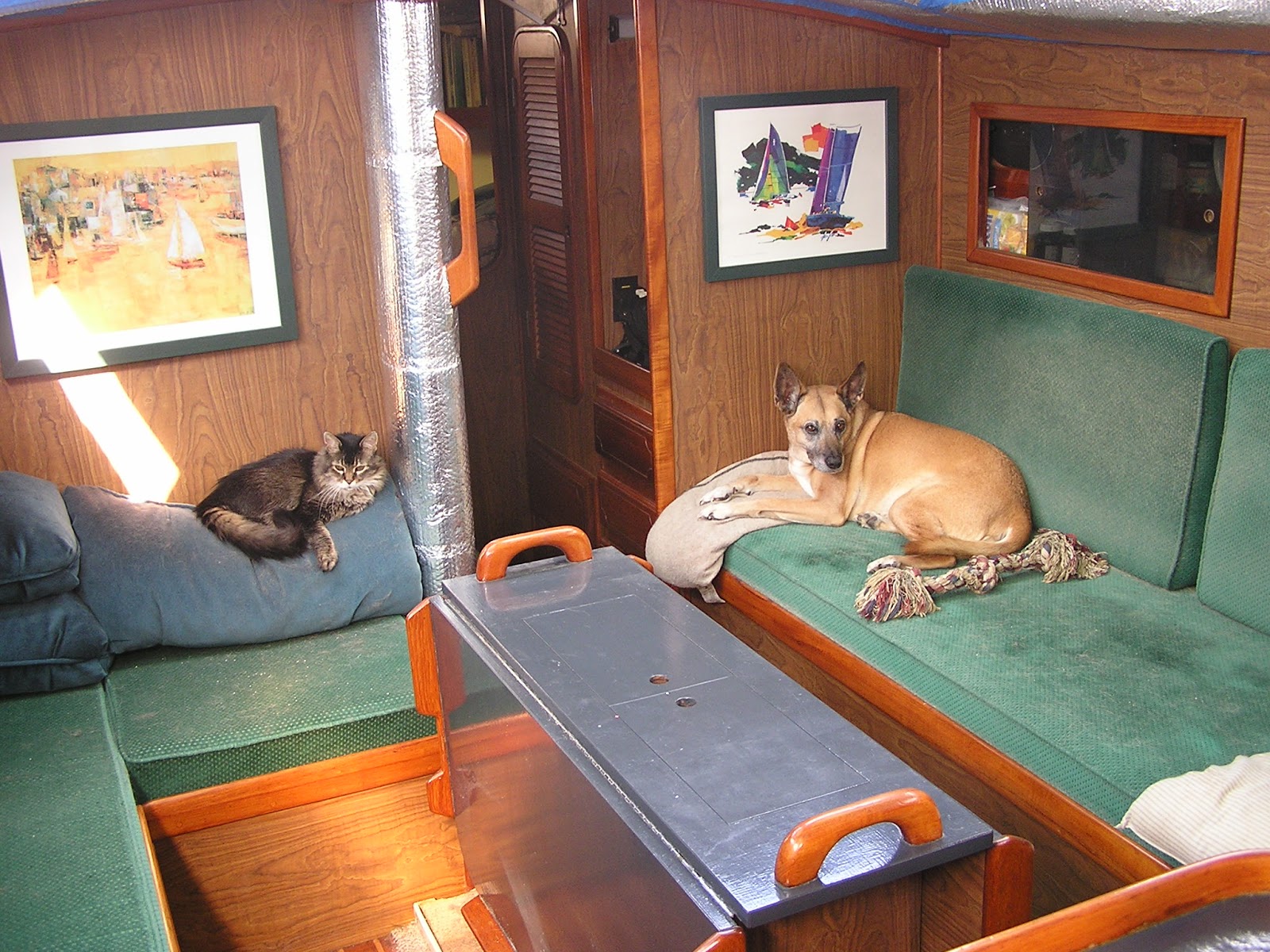
Another view of the mast.  Don't the pets look warm and relaxed?

The area around the nav station, and the louvers in the companionway drop boards were wrapped.

Overhead, too.  We didn't do the hatches because it would just be too dark.  A bonus; the silver reflected light and made winter less gloomy.

In addition to the silver, we used clear heat-shrink plastic meant to provide temporary insulation for house windows on the glazing.

Above the range.

We did every inch of hull!

The blue tape is 60-day painters masking tape.  It did pretty well in not leaving too much mess when we removed it.

More blue tape.  The whole project took about a week.

Lots of curves and irregular surfaces.

We did the insides of the lockers too.


In the v-berth, we used supports of plastic to keep the bigger pieces in place. Note the small electric heater on a shelf near our toes.  Toasty!


And outside, we built a frame of wood and PVC and draped plastic drop cloth.  We got a wonderful greenhouse effect on sunny days.

Here's the entire enclosed boat.  Bright and cozy, though we couldn't see out through the translucent plastic.


Antifreeze jugs half full of water held the edges down in the wind.

Here's part of the framework of PVC as we peeled the plastic back in spring.

More of the framework ...


We made the frame this tall so Dan could work on the deck during the winter.

Nautical version of a geodesic dome.