Thursday, March 21, 2013

Our Aruba Vacation, Part 3: Diving - The Best and the [Worst?]

We both really enjoy scuba diving, and this trip we had quite a range!  (If you're ever on Aruba and want to give it a try, we dive with Aqua Windie's Water Sports and I can't recommend them enough.  Family-owned business and in addition to excellent quality equipment and instructors, you'll feel like one of the family by the time you're done.)

About a week into our trip we scuba-ed at Baby Beach on the southeast end of the island.  It's considered a challenging dive, because there is generally a lot of current.  (This is the place where an American tourist a couple of years ago was either swept out to sea while snorkeling, or murdered for the insurance money, depending on which story you believe.)  But there were five of us who had been diving together before, and the divemaster agreed we were all skilled enough to attempt it.  Dan and I had had other plans before we were invited along, which we rescheduled to take advantage of this rare opportunity to try something new.

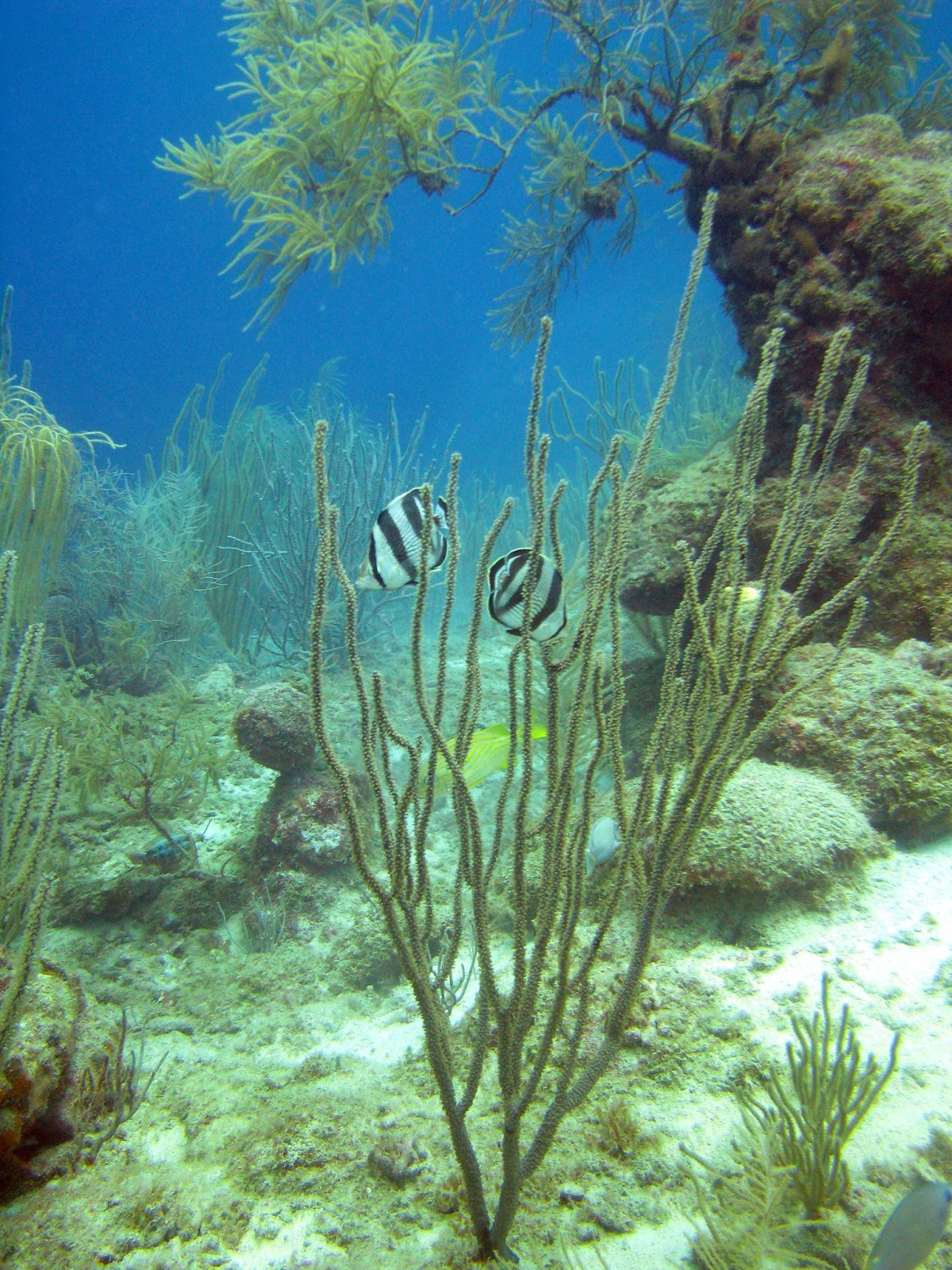
Knowing the area's reputation for current, we had planned it as a "drift" dive, where we would enter the water at one beach and get a lazy free ride downstream on the current until we came out at the next beach.   What we hadn't expected was just how strong the current was -- stronger than any of us could swim against for long as it swept us, helplessly and way too fast, past some absolutely spectacular sea life and scenery -- and not one of us escaped without some scrapes and bruises as the waves pushed us against the reef going out and coming in.  Wonderful and scary, we ended the day elated and exhausted at the same time.

Afterward, Dan and I agreed that this had been a once-in-a-lifetime trip.  Literally.  Because knowing what I know now, unless conditions are a lot milder, I don't think I want to attempt that dive again.

Exactly a week later, though, we were diving again.  It was a spectacular weather day, the most perfect diving conditions we'd ever had.  Easy, relaxed, and glorious contrast to the previous week.  After our second dive of the day I told Manon and Ed, who had both been with us the previous week, that I thought I'd never want to dive again.

"What?" Ed looked at me in amazement.  "Last week, after Baby Beach, I could understand you saying that. It was a tough day.  But today? Today was gorgeous! I don't get it!"

"Yes," I said.  "Today was gorgeous.  It was absolutely perfect - the company, the weather, the sights, everything came together perfectly.  The best its ever been.  That's just the point, it will never be that perfect again.  Ever after, will be a letdown."

(Photos by the incomparable Manon Houtman.  More of her dive photos are in this post from 2 years ago.)


Tuesday, March 19, 2013

Our Aruba Vacation: Part 2 - OF COURSE It's All About the Beach!

A brief picture essay for our friends who are living in the snow-zone:
What else can I say? As soon as I got to Aruba, I got my toes wet in the ocean.
The beach at the resort where we stayed was lovely and not too crowded.
We were there for just about every sunset, people-watching,  being romantic, playing, or just being a bit silly.
Watching the boats sail past on the trade winds,

...And the pelicans diving for dinner.  


Plenty of afternoons reading trashy novels, too.

Monday, March 18, 2013

Our Aruba Vacation: Part 1 - The Basics, A Geography Lesson

(reprinted from my blog from 2011, last time we were here we stayed all winter)

Yes, we love this desert island in the southeastern Caribbean. Here’s your geography lesson for the week (winking at H. if she’s reading).The island is 19 miles long and 6 miles wide. Politically, it is part of the Netherlands but has a semi-independent status. As I understand it, the island is self-governing but Holland takes care of some things such as national defense; I think it’s somewhat analogous to the relationship between the U.S. and Puerto Rico. The local language is Papiamento (more on that in a moment), but everyone is wonderfully multilingual and generally speak 3 other languages in addition – Dutch (Dutch is used for official business, and also there are many tourists from the Netherlands), English, and Spanish.
We studied a bit of Papiamento; I love the insights you get into a culture by understanding the structure of the language. In Papiamento, the pronouns for ‘he’ and ‘she’ are the same – does this imply an underlying gender equality? There are 3 different words for ‘relax’ but only one for ‘work’ – don’t you love those priorities? (We have no way in English, for example, to distinguish between ‘relaxing by resting’ and ‘relaxing by playing,’ if you get the idea). Best of all, they have no word for weather, and no jobs for weather forecasters!Why bother? It’s always 82 degrees and sunny, and south of the hurricane belt.
The trade winds blow constantly from the east. The iconic divi-divi tree, something of an island symbol, shows the effects of these winds by growing only in one direction [photo – divi tree]. The windward (northeastern) side of the island is wild – rugged, dry, and desolate, waves crash on rocky cliffs.[photo – crashers and splashers] The leeward (southwestern) side is mild, with miles of gorgeous sandy beaches and extensive development – tourism is the number one industry. [photo – palm beach] There is also a bit of oil revenue and a refinery. There’s somewhat less grinding poverty, and somewhat higher education, than many other islands we’ve been on. The total population is about 100,000 (?) mostly concentrated on the downwind side. [pink areas on the map are population centers] Most of all, the people are utterly fantastic, friendly not because you’re a tourist and they want your money, but just because that's the way they are.


Or, to put the geographic location in a different perspective:


An Image of Winter, Part 2

Once I started trying to see what was there, instead of what I wanted to see, things went a lot better.  I'd still rather make pictures with words than with a camera, but here's a hint of what its like to live aboard in winter at a marina.  Note there are no people in these pictures.  That's because almost everyone has wisely gone somewhere warmer and/or dryer for the season.
View from the dock.

Lots of empty slips; but we're snug and dry inside our enclosure.

Spare dockline patiently waiting its chance to tie up a boat come spring.

Ice on isinglass.

The image I intended, that started it all.

The odd shape of this finger pier is emphasized by the snow.

Dock cleat and reflections of a clearing sky.

This guy is not happy about the cold!