Thursday, January 13, 2022

A Fort You Can See, and a Fort You Can't

I alluded in a previous post about how different the Castillo felt, nearly empty of visitors. Perhaps that contributed to my lack of feeling any emotion at the visit. Had an email exchange with a friend who is one of the park rangers stationed there: "Saw [mutual friend X] at the Castillo when we visited last week ... it was weirdly empty and quiet without school kids or soldados, etc. Hope everyone stays safe and we're back to normal (or "new normal" whatever that looks like) soon." 


"It has indeed been strange, for those of us who remember the Before Times!" my friend replied. "What's also interesting is, we have a number of new employees who have come on board since March 2020 who have no idea what "normal" looks like for this place." So, a brief photo tour, of the Fort you can no longer see, and what it looks like now. 


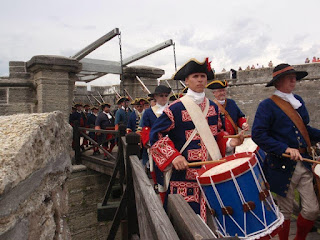
In the "Before Times" costumed reenactors helped visitors understand what things might have been like. 

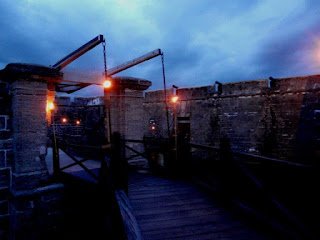
Special night events, candlelight tours, added the aura of mystery. We've attended and participated in many of these events, often portraying shipwrecked sailors. Next morning, energized by my interactions with people, I posted that my garb smelled of woodsmoke, black powder, and adventures.

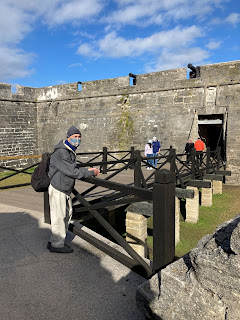
Preparing to visit last week ... what a difference!


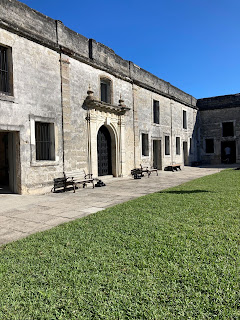
The weirdly empty courtyard. During the sieges the entire 1,500 townspeople stayed here for 1-2 months. Today, not a visitor in sight.

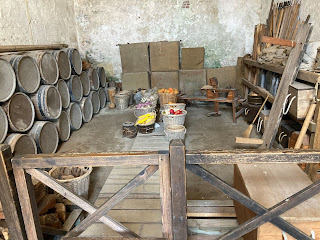
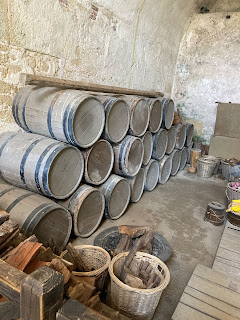
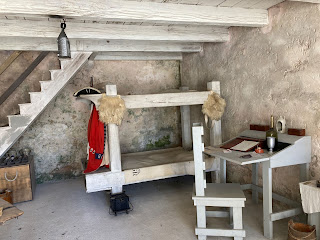
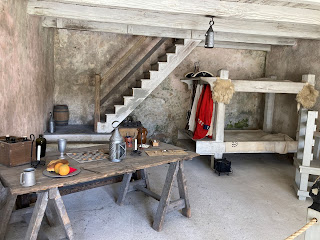
The casemates were originally used as storerooms for food, tools, gunpowder.


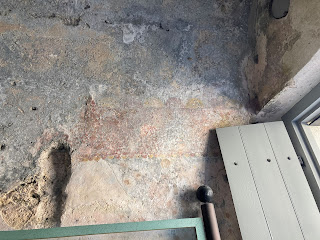
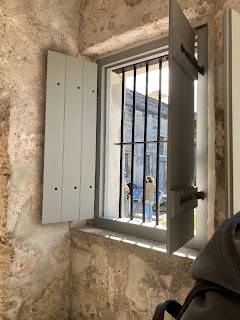
Then later during the British period the walls were expanded and these rooms were used as living quarters.

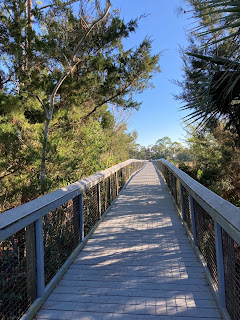
After this visit, and the administrative work which had been the primary motivation for our trip complete, we spent an hour or so the last morning at the site of Fort Mose, 2 miles north of the Castillo. I delight in the rarely-told story of this place; the first free Black settlement in the US; the place where escaping enslaved people folloowed the Underground Railroad south instead of north from Georgia and South Carolina, to the then-international border between England's and Spain's colonies. In the US, we tend to think of ourselves as derived from the British – Boston Tea Party, 13 original colonies, 1776 and all that. We forget that New York was Dutch, Michigan and Louisiana were French, and Florida was Spanish. Unlike the Castillo, this fort is gone and its struggles remembered only in stories, the landscape given back to the birds and marshes. 

The long boardwalk to the site, dubbed "Walkway to Freedom."

It looks so peaceful, but it's anything but quiet, filled with the squawks, chirps, and quacks of the birds making their living fishing in the marsh.


An Accident of Time and Place (How We Saw the Town)


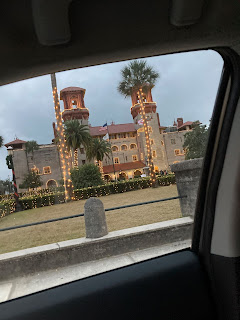
Seen through a car window, the lights are ... underwhelming

We continued our short visit to St Augustine that night. We drove around town looking at the famous 3 million white holiday lights, and I felt nothing. I was an observer of the city, but I wasn't “of” the city any more. I felt on the outside, looking in. Maybe it was my heart, protecting itself again. Or maybe it was the difference between being in a car, and walking. 


I was texting about this with a friend the next evening, and he agreed. If we hadn't docked in the municipal marina, in the middle of the action, and had to walk everywhere, we'd never have seen and appreciated the city's fine details. We'd never have spent long enough to learn the history in more than the broadest-brush overview. We wouldn't have had the chance to play pirate on the Black Raven, or gotten to volunteer at the Castillo or on El Galeon. We'd probably never have fallen in love with the city. 


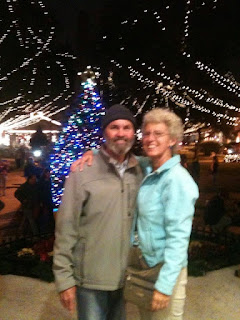
In the city, of the city; strolling the plaza during Nights of Lights in the Before Times


This was probably the most profound lesson I learned from 4 years of touring with the Spanish tall ships and 8 years on our own boat. Every port we visited, we saw the city the way it had originally evolved, growing outward from the waterfront. And we'd learned about it human-scaled, walking scale. These narrow cobbled streets were laid out long before cars were even a dream. Our frontier was maritime long before Hollywood glorified the “wild West.” And coming into town by car, coming in from US-1 and the brightly lit strip malls; historic downtown seemed just a dusty crowded inconvenience, with no real story to tell. (Also, coming into town as a crew member on a dramatic tall ship, I was a rock star. A far different reception than I would have gotten as “random retired lady driving a minivan!”)  


We think so much depends on big decisions (“What state shall we move to? Colorado? Florida? Maryland?”) But sometimes it's the tiniest microclimate -- downtown marina, walkable but parking is a major hassle? Or one that's a little further away but car-friendly? -- that has the biggest impact on the way we perceive the place. 


[FWIW, this may also explain why we haven't felt at home in Annapolis yet either. Our marina is located in suburbia: not rural enough to enjoy the peace and quiet of nature while living aboard, yet simultaneously not central enough to really participate in the downtown vibrancy and experience (Covid notwithstanding). Hopefully things will settle to the point where we can get more involved in the future.]

Monday, January 10, 2022

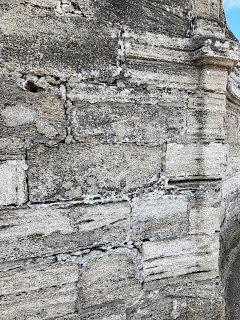
Stones


A pile of rocks, or stones with souls? This is part of the western wall of the gun deck. An accident of geology led to the almost magical resilience of the coquina walls to cannon fire, which in turn is why the Castillo never fell in battle, but only changed hands by treaty. 


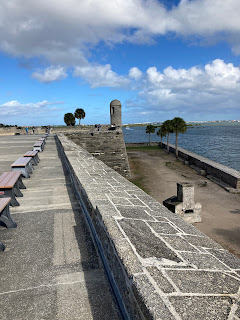
Gun deck and sentry tower January 2022 ... almost empty of visitors

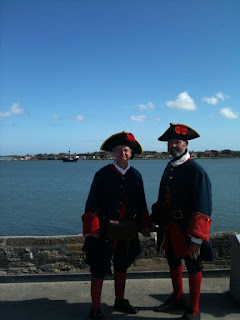
Us, dressed as soldados in almost the same spot eight years previous. The Nao Victoria is behind my right shoulder on its way to a visit of St Augustine. Little did we know how much that ship and the others from the Foundation would shape our lives!


We made a quick trip back to St Augustine to renew our driver's licenses. There's probably an easily-explained reason this couldn't be done online (in the middle of an ongoing pandemic (!) ), but the person who can do the explaining … isn't me. An-y-way, we packed our bags, scheduled as many get-togethers with our local friends as we could orchestrate on the calendar, and we were off.


As it turned out, we bolted out of Annapolis the day before we had planned to, due to forecast bad weather, and good thing too – there was a massive, massive traffic disaster that would have had us stuck in sub-freezing weather on an ice-covered I-95 for more than 24 hours if we had left on our original schedule. Hey, an extra day in St Aug? I'm not complaining!


Actually I wasn't quite sure what emotions to expect, going back. It about tore my heart out to leave St Augustine for Annapolis a little over a year ago and ever since, I've been splitting my loyalty between the two cities. I claimed that I've got “one foot on the boat and one foot on the dock”.  As you can imagine, that's a pretty precarious place to be, much wiser to make a commitment to one or the other, because with one foot on each, a minor shift and you're off balance and fallen into the water between the two. Which about describes my mental state, this past year.


With an extra half day unscheduled, and the weather warm and dry, we headed immediately to our favorite bit of history in town, the Castillo. From our very first visit I had been drawn to this place and its story. I had spent so many hours dressed as a soldado (Spanish soldier), standing on the gun deck gazing out to sea exactly as my predecessors would have done 300 years earlier, dressed in the very same uniform. The difference of course is that my duty was far less stressful – they would have been fearing for their lives and looking for enemy ships while my biggest fear was being asked a question by a tourist that I couldn't answer!


“There are people with hearts of stone; there are stones with hearts like people.” This quote was the hook to a popular Israeli song (protest song?) from the 1960s, more lyrical in the original than my translation. It was written about the remaining wall of the temple in Jerusalem, but stones with hearts or souls seems to me to apply to other special places as well. I've always thought the Castillo had a unique aura and attributed it to the fact that the place had never fallen in battle but had safely housed the city's residents through two long English sieges. I'd felt the reassuring “my walls will keep you safe” vibe the very first time I'd visited, and every other time since, through public crowds and  special events and night events and private after hours tours that were closed to the public just staff and volunteers only. Now with attendance still limited by pandemic restrictions, no school kids or cannon firings and a smaller number of visitors, I thought I'd feel that again. 


Instead, a different quote came to mind. I was reminded of the heroine of a fantasy/sci-fi story I had read as a kid. She'd been given a pair of magic spectacles, and when she'd put them on she was able to walk through the wall of the place in which she'd been imprisoned and escape. Next time she got into a jam, she tried the glasses again, but this time got no help. Maybe they were meant to help just that once, she mused. “But now, the magic has gone out of them, and they are simply glass.” 


The park staff had done a commendable job of setting up vignettes in the different casemates to tell the story of the fort through time in the absence of costumed living history reenactors, but some of the magic had gone. The walls were … just rocks, silent. Though sometimes I wonder whether anything had changed at all, really, and my lack of feeling anything was just my heart's way of building protective walls around itself, to prevent being torn again.

Tuesday, December 14, 2021

Science! Just Like Magic ... Except It's Real


Classic science fiction author Arthur C. Clarke is famously recorded as saying, "Any sufficiently advanced technology is indistinguishable from magic." And there's no other way to describe the gloriously elegant treatment that Dan received last Thursday (Dec 9) to resolve his hand tremours. 

See, we describe the tremour as a very very good "bad thing." Because 15 years ago when he had brain cancer he wasn't expected to live long enough for these to develop. So we're delighted to have encountered this.

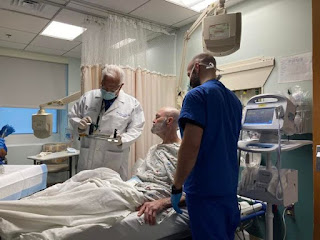
The conventional approach involves a wire electrode implanted in the brain and a battery under the skin in the chest (think like a pacemaker), but his neurologist emphatically did not want any surgery that could be avoided. Focused Ultrasound is a new technology where hundreds of energy beams converge on a particular spot deep in the brain. Each beam alone is too weak to cause any damage, but where they intersect there is enough power to sear the spot causing the trouble. Non invasive, effective, and quick healing time. The linked article explains it pretty well; and here's a photo tour of Dan's experiences. 

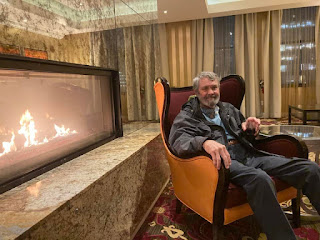
We stayed the night before in a gloriously elegant old hotel in Baltimore, right near the hospital. Here's his last night of having hair (more on that later).

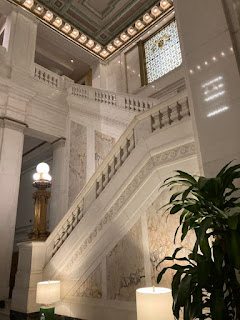
The hotel is the repurposed headquarters offices of the B and O Railroad. Obviously built to impress! 

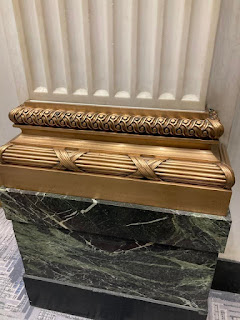
Detail of a column at the hotel.


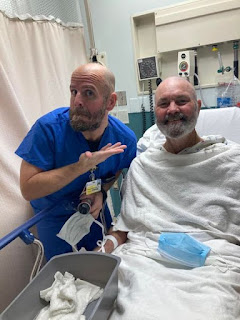
The day of the treatment started out with ... a haircut. Even a single hair could deflect one of the many energy beams that had to converge on that particular spot in the brain, so off it all came. Nurse Chris (who was excellent, competent, humorous, and calm) claimed that now they were twins. And this was an interesting, and very human moment: I had said I wasn't going to share any pictures of Dan being vulnerable. Chris disagreed -- "Sometimes these moments are also part of life. Don't pretend it's always only good." 

The renowned Dr. Eisenberg explains the frame that will hold Dan's head in place during the treatment. Dan’s case was extra complicated because they had to work around the previous brain cancer scars. Drs. Eisenberg and Fishman, mentioned in the article, were on his care team and said his case was a unique and enjoyable technical challenge because they could only use 800 or so of the 1000 beams due to that scarring. The amazing thing is that unlike the 50-60% reduction in tremour expected Dan is a whopping 80%! Overachiever! 

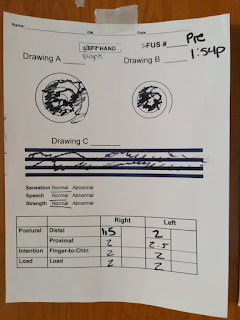
One measure of tremour is the ability (or lack thereof!) to trace a pen along a spiral maze without hitting the walls. Here's the "before."

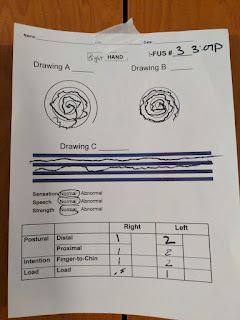
The "after" is much improved; and he continued to improve after this!


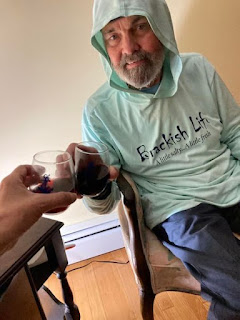
With nurse Pamela's explicit permission, he was allowed a small glass of wine the next evening. Triumphantly, he was able to hold out his glass at arm's length for a toast. This is something he hadn't been able to do for years for fear of spilling.

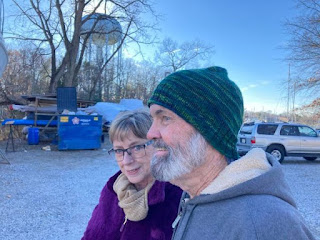
Sweet friend Penny knitted this gorgeous hat for him when she learned they had had to shave his head in December. He said it warmed him twice - once from the thick soft wool, and again for the kind thoughts. 

And the ultimate proof -- able to hold a full coffee mug at arm's length without sloshing.


Friday, August 20, 2021

The Pandemic Pantry Part 2 -- the Actual Plan


In the restaurant industry they call it "PAR level" -- Periodic Automatic Replenishment (or "Replacement" or "Resupply" depending on who is writing the acronym). It's a pretty structured method of making sure you have enough food on hand to prepare the meals until your next reorder time, without going seriously under (missed sales and unhappy customers) or over (food spoilage and storage issues). I'm quite committed to the concept, having developed an informal version years ago when we had little money and less time, and built a computerized grocery list organized by the aisles in our grocery store with the number of boxes/cans to buy of each item, the Saturday after payday. Little did I know I was reinventing the wheel.

In suburbia, if you planned wrong and ran out of an ingredient, it's inconvenient. You might have to run out to the store unexpectedly, or pay more for it. Or you might have to change your planned meal to something else. When we were cruising, we bought what was available on the little islands, and the list was more like a general guideline or suggestion than an inventory. Exploring new food possibilities was part of the adventure, after all. But at sea, whether on our own little Cinderella or the mighty El Galeon, if you're out of food it's way more than just inconvenient -- there's no popping round to the grocery store when you're in the middle of the Atlantic! So keeping the storeroom ("gambuza" in Spanish) properly supplied was a much more rigid process.  

While we were in lockdown it was like trying to apply every aspect of pantry management, all at once. Like being at sea, our visits to the grocery store were very infrequent and limited. Like visiting small islands, not everything was in stock at all times, so we had to buy it when we found it, or improvise. We were trying to save money, and we wanted to cook extra-healthy to keep our immune systems up. Put it all together and it was ... a lot. 

But wait, wait, there's more! I had learned on the Galeon how distracting it is to have that little background buzz of "what shall we make for dinner" popping up every day around mid-afternoon -- until it was no longer there. When I was crew, dinner was whatever the cook decided, and when I was assistant chef, that was part of my actual job, not something I did in addition to my job. Well, during lockdown I just didn't have the mental bandwidth for complex meal planning. So I built a basic inventory list of about 40 core ingredients. (Drinks, snacks, spices, plus some pantry staples like oil and salt and flour, weren't included in the 40.) Meal planning became simply deciding 2 nights per week would be fish-based meals, 2 nights egg-cheese-dairy, 2 nights plant-based. We found 5 or more recipes for each category that could be made with our basic 40, and put our kitchen on autopilot for a while. Now, if you're good at math you noticed that I only accounted for 6 days. One day a week was "wildcard." Sometimes wildcard would be experimenting with something new, sometimes it would be takeout, sometimes it would be instant ramen noodles, sometimes it would be inspired by whatever looked good at the farmer's market. Just enough to keep it interesting, but not complicated. 

At the end of lockdown we had saved an impressive amount of money by not eating or drinking out, lost weight, and stayed sane and healthy. I'm posting the "Basic 40"list (feel free to copy but make it your own; remember, it's a suggestion, not a prescription!) and the titles of some of the meals that can be made. It's not a shopping list with quantities, instead it's what you want to have going into the week so you can make whatever meal you choose pretty spontaneously and know that everything you need is on hand. You take inventory before going to the grocery store, and just buy enough to bring the level of food in the pantry up to PAR. There's some seasonality; we use butternut squash in fall and winter and swap that out for cucumber in summertime; use fresh tomatoes and corn in summer instead of canned, granola instead of oatmeal, and use fresh spinach instead of frozen when it's available; it's pretty flexible. Still working on the actual recipes in fits and starts. Some are in metric and some are in English; some need to be scaled down from a quantity that will feed a crew of 25. Someday it will be a book, for now, it's just fun. 


“BASIC 40 PANTRY LIST” 
(PAR for all = 1, except as noted; easily feeds two of us for a week no matter what we decide to eat)


CAN AND JAR
garbanzo beans (2)
cannelini beans (2)
mandarin oranges (2)
chopped tomatoes (2)
salmon 
tuna (2)
black olives (2)
green olives 
roasted red pepper 
green chilis
mushroom pieces
corn


DRY & BULK
lentils
rice 
small pasta (corkscrews, macaroni)
bulghur
couscous or quinoa
spaghetti 
bread crumbs
coffee
protein powder
peanuts
triscuits
flour (2 c)
instant potato flakes
corn starch
oatmeal


FROZEN
green beans
cut butternut squash
spinach 
cod (2 pcs)
salmon (2 pcs)


FRIDGE
eggs (12)
block cheddar
parmesan
feta
tofu or chik'n (plant-based chicken substitute)
butter (2 sticks)
sliced almonds
yogurt (2)
tortillas
cream or milk (or full-fat powdered milk) 


PRODUCE
onion (2)
purple onion
garlic
bell pepper (2)
potato (1 lb)
lemons 
bananas (8)
carrots


DRINKS
V-8 (4)
ginger lime ice (4)
BlackWing beer (4)
rum
red wine (3)
cherry juice or concentrate


CONDIMENTS, OILS, AND FLAVOURINGS
no dead birds boullion concentrate
coconut milk powder (3) or can
olive oil 
canola oil 
tamari
sherry vinegar
white vinegar
lemon juice
tomato paste tube
hot sauce
mustard


SPICES
parsley
basil
oregano
mint
dill
paprika
cumin
curry blend 
herbes de provence
chili 
fish blackening
salt
peppercorns
cinnamon
cayenne
saffron


SAMPLE RECIPES USING THE "BASIC 40"

BREAKFAST: 
smoothie with yogurt, banana, cherry juice, and protein powder
oatmeal (winter) or granola with yogurt (summer)

LUNCH:
generally leftovers rolled in a tortilla, or a room-temperature salad (the "mixed" salads below are great for lunch) or tuna or egg salad, or cheese quesadilla; or veggies and couscous 

MAIN MEALS:


EGG-BASED:
Shakshuka
Basque scrambled eggs (or other egg-and-veggie skillet scramble)
Cheese or veggie omelet with green beans and sliced almonds
Crustless quiche (spinach and mushroom; tomato and peppers; whatever inspires)
Spanish tortilla 
Butternut squash mac-and-cheese

FISH-BASED
Fish cakes
Pasta with olives, tomato, onion and tuna
Blackened salmon with wilted spinach salad
Potaje bacalao (Spanish cod stew with potatoes and chickpeas)
Moqueca (Brazilian cod stew in a coconut milk sauce)
Lemony lentil and salmon salad*

VEGAN (some have a little crumble of cheese)
Bean soup, stew, or chili
African squash/peanut stew
Curry night -- chana masala or trini aloo, and saag paneer and basmati rice 
Stir fry with tofu and vegetables
Baked tofu Veracruzana or Caribbean jerk tofu
Chik'n and rice with vegetables
Bean and rice variations – Peruvian tacu-tacu, Mujeddrah (middle Eastern lentils, onions, and rice), red beans and rice, etc 
Spinach-feta-garbanzo pasta salad
Bean, mushroom, or lentil burgers

MIXED (hard-boiled eggs + tuna)
Papas alinas (marinated potato salad) with gazpacho*
Salade Nicoise
Traditional Spanish salad


WILDCARD
pizza, dinner out, happy hour munchies with friends, ramen noodles, something from a can, the eggplant looked good at the farmers market so make pistou, etc. Tapas or Greek night – dolmas, olives, nuts, tzatziki*, spiced chickpeas, felafel, hummus. Breakfast burritos.

* Gazpacho, tzatziki, and lemony lentil salad also need cucumber; which is not on the basic 40 list. A  couple of soups, and the Spanish salad, also need a carrot; not on the basic 40 list. My favourite blend for stir fry includes red bell pepper, mushrooms, and tofu or chik'n (plant-based chicken) and also broccoli and zucchini (not on the basic 40 list)

Monday, August 16, 2021

When the Room is Complete Chaos (a step-by-step guide)

When the room looks like this ... 


... this is your tool kit!

Not directly boat-related, but the same approach that moved us from 3,000 square feet on land to a 33-foot sailboat I've found are helpful in other aspects of life. A couple of my land-based friends have been inundated/devastated/overwhelmed by a chaotic disaster of a room, and asked for help. 

 Not sure how to start? Here’s one approach designed to break down the "overwhelm." When you get right down to it, there are only 5 categories of things in a chaotic mess like the room above -- trash, dishes, laundry, things that belong somewhere else, things that have no home. 

So, pick up a big tote bag and a trash bag, and make 5 passes through the room. Each pass will require a bit more brain power, but by the time you get to the tougher ones your "decluttering" mental muscles will have been thoroughly flexed and ready for the challenge. 

The first step is the simplest. For #1, trash, just walk through the room picking up trash and putting it in the bag. Don't worry about anything else. No tough decisionmaking required. When you've gotten all the trash, put it out in the bin (or wherever trash goes where you are). 

Then, do #2, dishes. Walk through the room a second time. This time, pick up every dish or cup, bring it to the sink or dishwasher. Leave it there for now, you'll get back to it in a bit. We don't want to slow your momentum. 

Pass #3 is laundry. Go through the room a third time. Pick up the laundry, put it in the laundry bag/basket. Bring it to the washing machine if you have one in your house, or put it in the hall closet on it's way to the laundromat. The room by now is getting a bit better, yes? 

Time for #4, items that are out of place. Get your tote bag, walk through the room picking up the out of place items. Put them in the tote. Now, walk around the house emptying the tote and putting things in their proper places. 

Go back to the room for the last, and hardest, pass, #5, homeless things. Have you noticed that the first 3 steps were no-brainers? Then #4 needed a bit more thought? For this last step, we're going to seriously level up the decisionmaking. Take all the things that have no designated home, and put them in the tote. With them out of the way, the room should look somewhat orderly now. Congratulations! Pour yourself a cup of tea (or a glass of wine, we won't judge.) Now walk around the room with the tote bag full of homeless items in one hand and your cup in the other, define homes for the things you want to keep (whether in this room or elsewhere in the house), and put the rest by the door to donate at the next opportunity.

Congrats! You're done!

You earned this!


Saturday, July 10, 2021

The Ugliest Flip-Flops


WHY do I still have these? I got this pair of flip flops years ago, and I still have them though I never wear them. Let me tell you their story.


I got them with my friend M when we went to a launch party for a new brand of beer. The company had gone to considerable effort with the party, going so far as to close the street and truck in enough sand to make a "beach" party. (I'm not exactly sure why they did that when the real beach was just a couple of blocks away. Whatever.) The bands were excellent, there was tons of food and swag and free beer. The problem was that the beer was awful. M and I joked about how bad this beer was, it remains a running joke between us now even though she has since moved halfway around the world.  I won this pair of flip flops at that party. They are not comfortable. Really cheaply made, they don't fit right -- too long in the toes and too short in the heels. But they make up for being uncomfortable by being ugly. The soles are printed with the logo of that tasteless beer in gaudy colors. 


So, to summarize: I have flip flops I don't like, advertising a beer that I don't like, that I'm not at all sentimental about, taking up space in our storage. (Granted, they don't take a lot of space.) And I have much much better memories of friend M that I can call to mind whenever I want, photos and books and adventures we had together. So I really don't need these particular tangible reminders. Why, then, haven't they been thrown away?


Well, it's precisely because I can call M to mind whenever I want. But I have to actively decide to think about her. The ugly flip flops ambush my vision at totally random times and bring her up unexpectedly. Like she pops into my brain of her own volition, and says, "Hey, remember that time I brought the boys to your place and you went down the slide with them over and over again?" or "Remember when the Indonesian restaurant did a pop-up dinner in the middle of the mall?". Always a pleasant surprise. So that's why I still have those stupid ugly flip flops ... just for the randomness of it.

Thursday, May 13, 2021

Tiny Space Storage Hack: Bolsters and Pillows That Are Really Stuff Sacks


In this small a space, we need to make every inch count. And now that we're living in the land of four seasons again, we need to store off-season clothing. Stashing it in a locker didn't work -- moisture led to mold led to ruin of my best coat. So we came up with this instead: keep them out in the open, in the air, and make them earn their keep by acting as cushions!

These "pillows" are 14 inches/35 cm square with simple button tab closures. They hold flat-folded bedsheets or towels.


This "bolster" holds my off season clothing. It's 10 inches/25 cm diameter and 19 inches/about 50 cm long. Built as a simple cylinder. It has a drawstring closure, visible in the next photo.

The innards of the "bolster." Pro tip: it's actually two bags, an inner and an outer, with a layer of batting in between to make it softer to lean against and smooth out the visual lumps from irregularly shaped clothing. The fabric that makes up the end is a lightweight ripstop nylon instead of the heavier fabric that makes up the rest of the bolster, to allow it to be tightly gathered by the drawstring without bunching.


Friday, April 2, 2021

A Tour of Our Boat (Expanded, Updated, and Talking a Bit About Storage)


Life on a sailboat! It's romantic, it's adventurous, and it's like a turtle -- very slow getting around, but when we finally get there, we have our home with us.

It's about as tiny as small-space living gets. For almost 20 years and 25,000 sea miles, we've lived on a smallish sailboat 10 meters/33 feet long. Our main living space is a single room a bit less than 3 meters x 4 meters or 9x12 feet - 10 square meters/100 square feet. The designer managed to tuck into that tiny area everything we need - a place to cook, a place to eat, a place to socialize, a place to sit and think, and a place to sleep, helped greatly by multipurpose furniture. Of course, everything is built in, and bolted down so it won't go flying if we're tossed about at sea. And storage, though some of that storage happens in weirdly-shaped or damp quirky lockers dictated by the shape of the hull. Living in such a tiny space, though, has certainly forced us to think hard about our relationship to our possessions! Here's a brief photo tour, and I'll be following it with a few posts about strategies and tricks we've come up with to make our material lives fit. 


Here's the forward half of the main living area, set in its ordinary daytime configuration. There is storage tucked everywhere, inside the table, under and behind the seats, as well as the black sliding door lockers that are visible.

If we're going to have friends over for dinner, the sides of the coffee table in the center fold out to make a big dining table.

Or we can pull out the cushions and make a cozy double bed. 

Looking in the other direction, here's the tiny galley. Even though it's small, it still has a stove, oven, fridge, two-basin sink. There's a dish cabinet over the sink, and two storage lockers behind the stove and the working counter. Lids on the counter lift up to access a fridge, freezer, and more storage. We also keep dry and canned goods in the locker behind the settee just outside of the galley on the far right of the photo. Bonus - everything is in arm's reach at all times, LOL! The stove is mounted so that it tilts and swings; always level even if we're underway. In addition to being space-efficient, the U-shape is very secure and keeps you from being tossed to the floor by waves while cooking.


Just across from the galley is the navigation station (a.k.a. my desk). Under the liftable lid are stored everything from the ship's log and nautical charts, to ordinary office supplies and checkbook. Stairs lead up and outside to the cockpit.


Here's one example of the hidden storage - my "file cabinet" inside the table. At various times in our 20 years here, these lockers have also held tools, spices, electronics, and games.

Tucked neatly into the bow of the boat is the v-berth where we normally sleep (again, with storage underneath). It's as wide as a king-size bed at the head, but our toes snuggle together at the point of the triangle. Because it completely spans the width of the boat, with those sides, we can't fall out of bed! Rails along the sides provide a bit more storage.


Here's a bit more of that storage rail that runs along to side of the bed. It's got a wooden lip to keep things from sliding off in a rough sea; we added the brass wire to secure books. We've got limited space for books, so we keep in hard copy mostly reference books; things we read linearly like novels go on the Kindle. 

Between the main cabin and the v-berth is a short hallway. On one side is our clothing lockers and dresser.

This is the inside of the largest locker. 10 hangers and 4 shelves. 


On the other side of the hallway is the bathroom ("head" in boatspeak). The sink faucet pulls out, and the entire room becomes a shower stall -- it's designed so it can get wet, and has a drain in the floor.

I'm standing outside of the bathroom to take this photo - this is all there is!

If the weather is even remotely nice, though, we spend most of our time outdoors in the cockpit. And here's how we like it best, filled with friends! The guy in the gold shirt on the tall helmsman's seat, is the one who taught us how to sail. And though you can't really tell it from the photo, each side bench is long enough to stretch out and sleep on. And once again, the seat covers lift up to provide storage underneath.