Sunday, August 30, 2015

Philadelphia/Camden: Crew Perks


Tall Ships Challenge crew pass -- my ticket to everything


When we met up with the ship in Philly, almost the first thing that happened -- after the round of hugs, and the stowing of our backpacks in our bunks -- was this conversation:

"Here's your crew id. You need to wear it at the festival, and keep it safe because you'll need it for the other cities on the tour as well."

I had no idea, when I put on the pass, that it was also a ticket to the red carpet treatment everywhere.

Crew members wearing a pass get on the shuttle or water taxi for free.  Crew members wearing a pass do not wait in line, they walk to the head of the line and show the pass. (Guests of crew members don't wait in line either.)  We rarely were able to pay for our own beers; bartenders and random strangers took care of us.  People thanked us for being there.  We got weird and wonderful gifts.  The manager of the water district in Camden gave me a rubber duckie. A random visitor, upon learning that Dan and I were the only married couple both working on the ship, gave each of us half a "Spanish doubloon" so that we would always be together. The royal treatment continued in other cities.  In Portsmouth we were given t-shirts with the image of our ship printed on them. In New York, we were invited for free sails on the historic schooner docked next to us; I even got to take the helm briefly.  (Dan noted later that I was rather reluctant to give it back...) I absolutely loved it. Yes, what can I say, I'm a Leo, I'm a sucker for the VIP treatment.

My favorite thing by far, though, was the courtesy tours of the other ships, including the behind-the-scenes stuff that the regular visitors didn't see.  We chatted with the other crews about how they solved the problems of everyday life at sea that we all face: How do you divide up your watch schedule? What are your chores? How does your ship do in rough weather? And of course the most important question -- how's your food? I thought we were going to lose our chef to Pride of Baltimore after he saw their beautiful galley. And L'Hermione  had the ability to bake fresh bread aboard! (Baguettes, of course -- they're French!) I got a great tour of the Canadian training boat Picton Castle as well, docked directly behind us, on one of my breaks.  You know, the one I got to cut to the head of the line, just flashing my crew pass. (*smile*) Everything they say about Canadian courtesy and politeness is totally true.

Taking the helm of the schooner Pioneer in New York

We played tourist in the public areas of L'Hermione ...

... and their captain gave our captain and crew a behind-the-scenes tour.  Here, explaining the watermaker. 


Crew dining area, between the cannons on L'Hermione.  Note the hanging baskets; no scurvy here! The ropes holding the tables can be adjusted to keep the tables relatively flat if the ship is heeling over on a tack.

Visiting the Canadian ship Picton Castle, docked directly in front of us in Philadelphia.  Note the crowds aboard El Galeon behind me; we had about 3,000 visitors that day.

"What I Did Last Summer"

Remember writing those essays on the first day of school?  On Facebook recently my friend Cathy awarded me "best in class" for what I did last summer, crew on this crazy tall ship adventure.  Yes, you are right, Cathy, and I'm gonna need a longer bucket list, because, how do you top this?

After spending months as tourguides on the ship at the dock, we went sailing!  Saint Augustine, Florida to Portland, Maine and back again, stopping in Philadelphia PA, New York City NY, Portland ME, Portsmouth NH, New London CT, Wilmington NC, and Charleston SC


So, what did I do last summer?  A whole lot of pulling on lines and coiling ropes, and everything is done the old way, by hand, with blocks and pulleys and muscle.  I learned the names of a lot of those lines; the little ones that furl the sails are called brioles in Spanish. (I have no idea what they are called in English.)  Brioles? Sounds like something I'd order in a fancy bakery along with a latte.
El Galeon has six miles of rope rigging. And I have real sailor-girl callouses on my palms.  Some days it felt like I had coiled every one of those six miles of rope!

It's a very physical life.  I spent my share of time doing this:
Teak decks need to be wet with salt water.  The salt holds the moisture and keeps the wood from drying, cracking, and shrinking ... hence preventing leaks.

And, more excitingly, this:
I have many pictures posed at the helm, most in period clothing, taken with great cameras by real photographers.  And those pictures are gorgeous.  This one? Not so gorgeous.  My (21st century) clothing is rumpled and my hair is messy, but this photo is definitely my all-time favorite. Why? Because this one is the real deal.  I'm on the ocean between Philadelphia and New York, and I'm actually steering the ship!

Sailed into big cities, and cute small towns.
I loved the contrast between our ancient ship and modern glass and steel skyscrapers in New York.
Walking around on our time off in Portsmouth
The crew became my family:
Photo by Karen Gajate, Smiling to the Wind
Then hurricane Erika was predicted to hit near St Aug, and we had to leave to protect our own boat. A four hour car ride, and just like that, it was over.  We were back from the 17th century to the 21st. I'm still (of course) processing the whole experience and there are things I want to write about in future blog posts.  Not a trip log, just "things of interest." Random thoughts from the voyage. Was I fundamentally changed by the voyage?  I don't think so, but then again this wasn't my first time at sea.  Still there are some new thoughts I hadn't thought before.

Friday, July 10, 2015

News Flash

We set sail for Maine on Monday.  My laptop charger has died, so no updates here for a while.  I'll try to leave notes on Facebook.

Friday, July 3, 2015

Philadephia - New York photo tour

I have a lot less internet time so far, than I expected.  And frankly, I'm too busy having adventures, to have time to write about them!  But here's a quick photo dump ... more coming, and more on Life Afloat's facebook page ...

Our first event in Camden was a fundraiser/reception for the city's leadership and included this live painting from a local artist

sunset over Philly

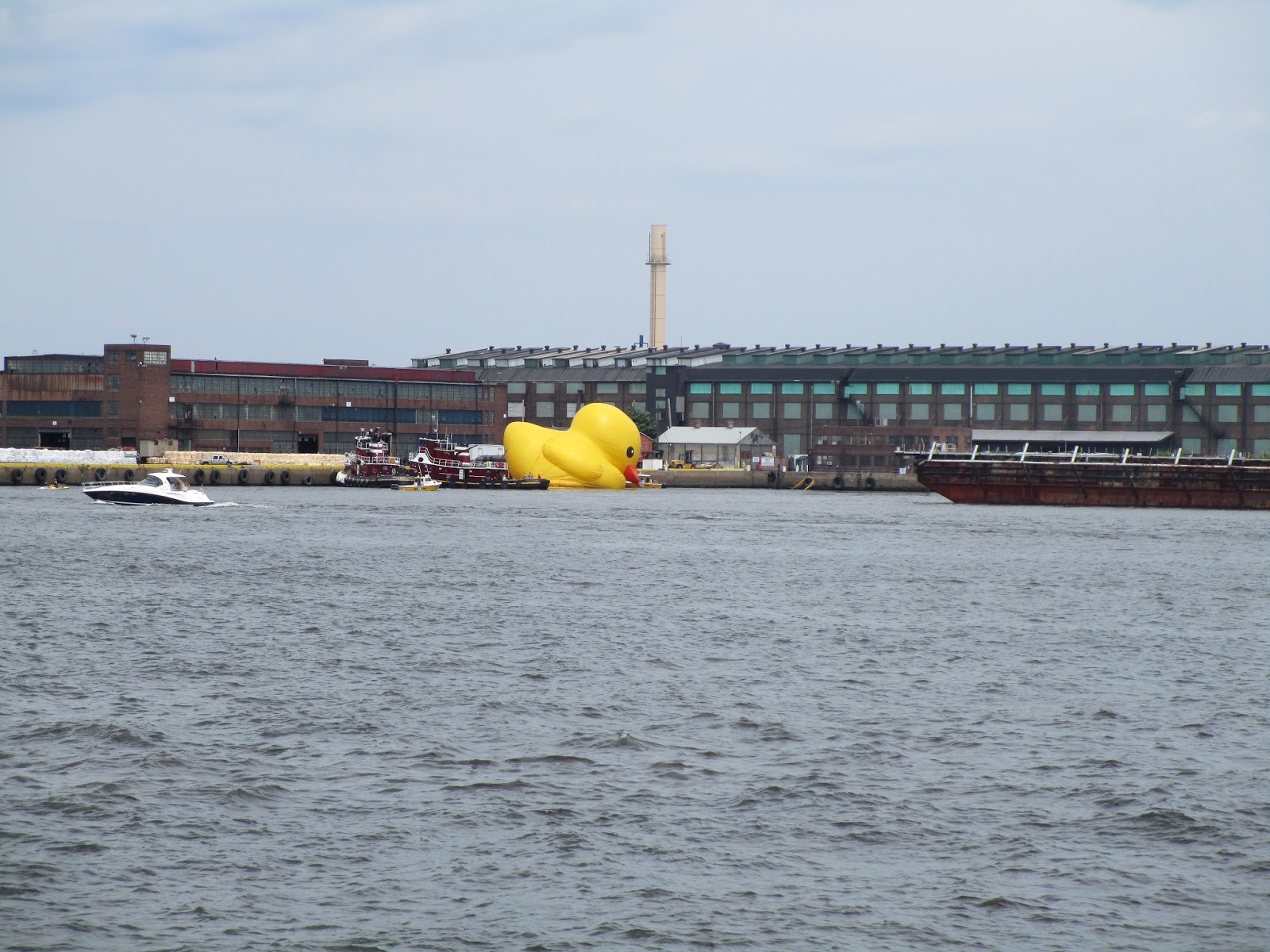
I was so excited to see the rubber ducky, but he was damaged.  I've got my little rubber duck souvenir, though.

Beautiful full moon sail on the way to New York

I've got so many pictures at the helm that are more beautiful.  But this one is probably my favorite, despite the rumpled clothing and messy hair.  Because this one -- it's the real deal, I'm steering the ship!!!!!

On the cutwater deck with some of my crew friends

Dan and Choco working on a splice

Fire drill, and safety training

Sunset at sea


Ancient cargo ship meets modern cargo ship

First view of New York City in the mist

Everyone's excited to see the Statue of Liberty

Coming into New York with the iconic skyline


My job during docking ... ringing the bell!!

My friend Teaira

Tall ship ... very tall ship

You know all those photos of toes relaxing in the sand?  Here's ours, exhausted on the forecastle deck after our two-day, two-night passage.

Sunday, June 21, 2015

Departure Day

Through the Bridge of Lions and ocean bound!
The day of departure had perfect weather.  The ship motored through the Bridge of Lions, ringing their bell in a farewell clang acknowledging the well-wishers lining the bridge.  The living history folks at Castillo de San Marcos fired a single cannon shot farewell.

View of the departing Galeon from the gun deck; photo by Castillo de San Marcos National Monument
Our plan, since we couldn't sail this leg, was that we and another American crew member would follow with the dinghy and get some photos.

Following the ship out; that's us in the little bitty dinghy to the right; photo by St Augustine 450th Commemoration
In addition to the photos, we had another job.  About 3 weeks ago, the Galeon was struck by lightning, damaging all the electronics. There had been a mad scramble to get everything working again. On the scheduled day of departure, all was fixed except that the autopilot needed to be recalibrated.  (For the non-sailors: in practice, this meant they had to take the boat out in open water and go a mile or two out and back, and then turn in circles and various other maneuvers so the autopilot learned how much to turn the rudder to make the boat go where it was intended.) On Cinderella, this was calibration was accomplished in an hour or two on the Chesapeake Bay.

A heavy rainstorm on the Galeon, viewed from the shelter of the galley.  Every time the photographer's flash went off we all jumped, thinking it was lightning again!  (Photo by Teaira Marque)

The Galeon, however, is a big ship, not a little sailboat, and everything is bigger and takes longer.  For one thing, there was no place in Matanzas Bay big enough and deep enough for a 170-foot ship to turn circles.  The job would have to be done at the edge of the open ocean, actually, beyond the sea buoy at the St Augustine inlet, about a 4-mile dinghy ride from the dock.  We planned to follow the ship in our dinghy to the sea buoy, and then the ship would continue out into the Atlantic, calibrate the autopilot, then return to the sea buoy where the electronics tech (who was a contractor from a Florida company and not a member of the crew) would leave the ship and we would take him back to shore in our dinghy, and the ship would continue north.

Going out to the sea buoy in our dinghy was something we'd only consider in good weather (which we had) as it was about the limit we felt safe.  We got there without incident, and proceeded to hold station while the Galeon sailed away to turn circles.  It was a calm, beautiful morning.

They sailed away ... and kept sailing! They were perhaps having trouble with the calibration?  We chatted and chilled, hanging out at the sea buoy for about 45 minutes, then finally saw the ship start to turn back.  Now I know what a shipwreck survivor feels like, we three bobbing about in our little dinghy surrounded by nothing (except in our case we were safer than a real shipwreck survivor, we were right next to the whistling sea buoy, very visible on radar).  The ship came closer to us, grew bigger and more beautiful in the sunshine .... and then at the last minute turned away again!  What was going on?  We hailed them with our handheld VHF, which died halfway through the conversation.  I had one bar of cellphone signal so I tried to phone the boatswain, who couldn't hear me. We sounded like a bad Verizon commercial "Can you hear me now?"  Finally we relayed through the crew member who was doing shore support.  Our plan was to continue to wait at the buoy and when they came back, they would ring the bell so we knew it was time to maneuver close to pick up the tech.  We had it all planned, how we would come alongside, close to the ladder built into the side of the ship, and on the downwind side as we'd been taught by the Navy, so the bulk of the ship shielded us from the waves, for the tech to descend.  We had it all worked out.

"Chasing Galleons" ... that smudge on the horizon is our ship! The dinghy feels awfully small at the edge of the ocean.


Except, the tech wasn't finished.  We had been bobbing around the sea buoy for almost 3 hours, the wind was started to pick up, it was not all that strong but it was from the east, and the tide was ebbing so we had wind against current and it was getting choppy.  It was a beautiful day for sailing but not such a great day to be too far out from land in a little dinghy. Clouds were beginning to build over land, too.  Finally we got the word that the calibration was not going well, and we were feeling unsafe staying out much longer, so we came back to shore.

We got very familiar with the buoy marking the entrance to the St Augustine inlet from the Atlantic 

In the end the tech was out there for six hours turning circles.  They finally had to pick him up to bring him back to shore using the local law enforcement police boat.  Dan and I went out that evening for a dinner cruise with our friends on the Black Raven, and we still saw the Galeon, on the horizon, finally sailing away.

For the ship, a (hopefully) pleasant and uneventful passage to Philadelphia awaited.  For us, the usual last-minute jobs to prepare Cinderella to be left unattended; and then a road trip to rejoin the Galeon in Philadelphia.

Friday, June 19, 2015

Starting to Feel Real (Four Catch-Up Posts in One)

Over the last few weeks we've been getting more and more involved, often spending as much as 6 days a week at the Galeon doing carpentry, cooking, and standing in the sun talking with visitors. We've been spending more and more time behind the scenes, and feeling more and more like crew instead of city volunteers or members of the extended Galeon "family."  Photo highlights, because not all our friends and family are on Facebook some of these are repeats.

Joining the Crew: One day Fernando (the ranking person on board in the captain and first officer's absence) came over to Dan and was chatting away oddly about nothing in particular.  This actually went on for a while until Dan finally had one of those disorienting moments; Fernando's bright shiny name tag read "Dan Lunsford."  It had the logo on the left, and the flag on the right, and, yup, right there under the name it said crew.  Crew!  I had about the same experience.  He was as delighted to give us the news as we were to receive it. We were official.


No Limits:  During the A to Z blog challenge in April I posted that as soon as my back stopped giving me reminders of its existence I was going to try to climb the rigging to the crows nest on the main mast.  May 29th was "no limits" day when with the help of a friend in the crew who sometimes had to give my uncooperative right leg a little boost, and another friend who preceded us, I went up, becoming, I believe, the oldest woman to have done it.
Making my (slow) way up ... with every step the view got better.

Reaching the trap door in the floor of the crows nest (photo by Paulina Salcido)

The view from the very top, looking completely over Anastasia Island east to the Atlantic.  I didn't get that high, this is Paulina's photo.

View from the top in the other direction, west over town.  Paulina's photo.
I thought they were indulging me, since I really wasn't going up to perform any task of value to the ship and in fact it took some time away from other things, but it was a very slow afternoon and the few visitors who were there seemed to appreciate the demo.  I came down to a round of applause. There were lots of high-fives, more as though I'd passed some kind of initiation test joining the crew that everyone had been wondering when I'd get around to, than the sense that I'd wasted anyone's time to accompany me. This is a generous culture.

Ummmm... what are we getting ourselves into?

"It's starting to feel real." I posted on my Life Afloat page on Facebook. "Saturday we brought our passports and sailing c.v. to be scanned and emailed to Spain; they particularly liked the certificates showing we'd completed Coast Guard coastal navigation courses. This morning we each stowed two small duffles of clothing and other items on the required equipment list (foul-weather gear, headlamp/flashlight, knife, ...) on what will become our bunks next week. Then a very thorough bilingual tour throughout the ship, briefing on the "fire plan." My homework for this week is to memorize a rather ominous list of words that I hope never to use, because in an emergency there may not be time to translate: fuego (fire), hombre al agua (man overboard), and abandono del buque (abandon ship). Oh, and BTW, the photo is an aro salvavidas, I now know."

"aro salvavidas," useful to throw to an "hombre al agua"
The tour also included explanation of some of the mysterious stylized pictographs located strategically throughout the ship.  A red semi-circle with legs that looks a bit like it might be warning of a cockroach-infested area is in fact the location of an alarm button, and a hieroglyph that could show the route to make a left turn through a roundabout is a firefighting water hose.  Sheesh!  

 And just 'cuz I know you want to know how we're going to live, here's Dan sitting on his bunk.  In the photo book about the Galeon that we offer for sale to visitors, this area looks bright and cheerful and completely orderly.  It's kind of like looking at model home pictures on the internet; everything is perfect and rather sterile.  But the reality has a little more ... um, call it ... personality:

How it looks in the book for visitors


Reality!!!

And the inside of mine, the only private space I'll have for the next two months: 


I think I'm ready for this.  A lot of things about group living will take some time to get used to; others are common sense.  For example, one shipboard rule is that you do not use an alarm clock, since that would wake up everyone in the area.  Instead, you post your name and the time you want to be awakened on a chalkboard in the galley, and the person on night watch will wake you at the time you requested.  Your name is posted outside your bunk in masking tape so they can tell who's who even with the curtains closed. 

The first leg of our journey:

Was a "ride" from the slip to the fuel dock.  On Cinderella, this is kind of a necessary evil and I time it for slack tide whenever possible. Then, we came and went unassisted in our own slip, or with a single dockhand coming into a new place and then leaving on our own.  But on the Galeon, oh, my, the sense of scale is totally different.  For one thing, every single crew member who wasn't in the engine room had a designated place to be, and a specific job to do.  Dan's and mine was to stand on the main deck and position the "defensas" (fenders) to protect the ribs at the side of the boat from touching the dock.  Of course on our boat the fenders are the size of a small pillow, but on the Galeon they were probably 3 feet in diameter and heavy.  Turns out, our help with the "defensas" wasn't needed; we touched down as gently as a leaf falling in autumn and began the job of tying up.  

Organized chaos of docking ... and the size of the "defensas" we were handling. Photo by Teaira Marque; more of her photos of El Galeon preparing to depart are here.
Monkey's Fist!
And speaking of sense of scale, some of the docklines are almost as big around as my wrist.  So, here you are standing on the dock trying to toss one end of a big thick line to someone twenty feet away -- or twenty feet up.  How's that going to happen?  Answer: use a messenger line and an old-style helper knot called a monkey fist that would have been very appropriate to the Galeon's period.  The messenger line is a thin, easy-to-handle line with a weight at the end to make it easier to throw and to catch.  The weight is the monkey fist -- a heavy, round knot the size of a tennis ball.  The other end of the messenger line is attached to the big heavy dock line.  So you only have to throw the monkey fist, and when the sailor catches it, s/he pulls in the light line, which then pulls in the big heavy dock line.  Simple and elegant solution, and for all our docklines only one throw fell short, one time.  Here there is nothing to give you a sense of scale for these messenger lines with monkey fists lying on the dock.  But the one on the top, the messenger line is about as big as Cinderella's dock lines!


Here I am, at some historical festival somewhere, getting ready to demonstrate how the monkey fist knot is used.
Departure Day:
The weather was perfect and the crew was excited; departure was planned for high tide this morning (11:00).  Here's a photo from the dock, getting ready to leave for Philadelphia.  Again the sense of scale overwhelms me; I can't fit the whole ship in, from this close it towers above us, and every single crew member is standing at the position they were assigned at the briefing, getting ready to take a line.  This leg of the trip, disappointingly, we could not join them.  
Crew members in safety harnesses stand ready to help with departure.

Back when the US was a new country, Congress passed a law to help protect our then-fledgling transportation industry from foreign competition, that morphed into the "Jones Act." The short explanation is that only US-built, US-flagged vessels can carry goods and passengers between US cities.  Nowadays you see it more commonly in airplanes; only domestic airlines can operate between cities within the country.  But the law still exists and applies to the Spanish-built, Spanish-flagged Galeon.  But we're not passengers, right?  We're crew.  How to prove that, and the documentation required, is left to the discretion of each individual DHS office.  Florida is known to be very rigid in their requirements, so finally, reluctantly, we all gave up the idea of sailing and plan instead to drive to Philadelphia to meet the ship at the tallship festival.  We've been told that at New York and north, we can sail.  And more to the point, outside of the US -- like on the trip back across the Atlantic to Spain -- the law doesn't apply and we're welcome to join.  Ha!  I've sailed up and down the US coast before; it's the ocean passage I'm interested in! And that one has no restrictions!

Even though we weren't sailing, (yet!!) we had another job on this departure.  About 3 weeks prior, the Galeon had been hit by lightning and that had damaged many of the ship's electronics.  Everything had been repaired, but the autopilot needed to be recalibrated ... and that's a story for another post.